 The Honourable Maurizio Ronconi, deputy for the UDC, just can't stomach the victory of Vladimir Luxuria on Isola dei Famosi (more information about this can be found here). He says it's 'simply scandalous' that state television should transform a transsexual into a national heroine. Rather worryingly for a man who's been elected to parliament in a country that still claims to be a democracy, he doesn't seem to have grasped the basic democratic notion that the person who gets the most votes gets the bacon. Even if he or she is an unsuitable model for young people, as Ronconi claims. So listen up, Maurizio. It wasn't the naughty old disrespectful diseducational RAI that chose Vladimir, it was 56% of the voters who chose to invest a euro in choosing who'd win, whether or not they also pay their TV licence. This is how democracy works in the real world, Ronky, whatever might happen in the corridors of the UDC, so get used to it. One day you might also be exposed to a genuine popular vote. I can't wait.
Sunday, 30 November 2008
Lessons in democracy
The Honourable Maurizio Ronconi, deputy for the UDC, just can't stomach the victory of Vladimir Luxuria on Isola dei Famosi (more information about this can be found here). He says it's 'simply scandalous' that state television should transform a transsexual into a national heroine. Rather worryingly for a man who's been elected to parliament in a country that still claims to be a democracy, he doesn't seem to have grasped the basic democratic notion that the person who gets the most votes gets the bacon. Even if he or she is an unsuitable model for young people, as Ronconi claims. So listen up, Maurizio. It wasn't the naughty old disrespectful diseducational RAI that chose Vladimir, it was 56% of the voters who chose to invest a euro in choosing who'd win, whether or not they also pay their TV licence. This is how democracy works in the real world, Ronky, whatever might happen in the corridors of the UDC, so get used to it. One day you might also be exposed to a genuine popular vote. I can't wait.

Saturday, 29 November 2008
The merest whiff
A very small taste of my presentation a week ago at Rome's John Cabot University. It comes from the opening of The Scent of Cinnamon. I'm not being a tease (although I can be): this really is all that was filmed.
Tuesday, 25 November 2008
What I'd like to do to Berlusconi (while we still can)
You may already know this, but I've just discovered a whole sub-genre on YouTube of actions being filmed in slow motion. I had no idea. Some of them are intensely lyrical. Others aren't. This one, for example, isn't.
The dark side
 I'm not sure how much of this, from today's NYT, I understand, but it certainly feels exciting. Here's an extract:
A concatenation of puzzling results from an alphabet soup of satellites and experiments has led a growing number of astronomers and physicists to suspect that they are getting signals from a shadow universe of dark matter that makes up a quarter of creation but has eluded direct detection until now.
Maybe.
Richer and stranger...
 Don't miss the third leg of my Something Rich and Strange virtual book tour, at Scott Pack's essential blog, Me and My Big Mouth. I'm answering questions on order, sequence and, well, order again, which makes it sound a lot drier than it is. It's actually quite lively. Go and have a look and you'll see what I mean. And if you have any questions, please leave a comment and I'll get right back to you...
Stop press: Luxuria wins IdF
 Well, it's not Obama, but I'm happy to report that Italy's most famous transgender politician-cum-actor-cum-a-host-of-other-things, Vladimir Luxuria, has just won the Italian version of I'm a Celebrity, Get Me Out of Here, known here as Isola dei Famosi (Island of the Famous). It's less creepy-crawly than the UK version, but lasts ten weeks instead of three, requiring massive patience from both its public and the participants. Vladimir's victory over a strikingly attractive 24-year-old Argentinian called Belen Rodriguez, who may be famous now but certainly wasn't when the programme started almost three months ago, is a sign that in Italy, unlike many other countries, the people are way ahead of the politicians that represent them. Voting for Martina Navratilova or even Brian Paddick is one thing. Voting for a pre-op transsexual who's admitted to a period on the game, transformed a coconut shell into a makeshift handbag and represented Communist Refoundation in parliament is, I think you'll agree, another.
Over to you, Ratzinger.
Monday, 24 November 2008
A maid looking through the keyhole
There's a lovely piece by Peter Popham in today's Independent about the background to Fellini's La Dolce Vita. Here's an extract from it, with an interesting observation on how artists - some artists - gather their material:
The film caused a huge scandal when it came out, and narrowly avoided being banned. At the premiere, one outraged signora spat in the director's face. "We were furious with him," says Olghina, "because it wasn't a decadent city. Fellini, who comes from Rimini, based the film on gossip. He wasn't yet part of the city's life – he was like a maid looking through the keyhole." Yet no one denies that Fellini crystallised an amazing vision of Rome.
So long as men can breathe
 I’ve just finished Warwick Collins’ new novel, The Sonnets, which draws its inspiration from Shakespeare’s sonnet sequence and the circumstances in which it was written. It’s a brave man who decides to narrate an episode from Shakespeare’s life in the first person - who opts, in other words, to impersonate the man himself - and an even braver one who pens a couple of extra sonnets at crucial moments in the narrative, but Collins pulls off the first with considerable elegance and skill, and the second by the skin of his teeth, which is, as Collins himself acknowledges, only natural. Shakespeare wouldn't be Shakespeare if he didn't, finally, resist imitation.
The book weaves a context for some of the most famous sonnets, providing an entirely plausible sequence of events to explain the various mysteries surrounding their writing, although I admit to having a vested interest in Shakespeare’s presumed bisexuality, which gets short shrift here. What impressed me most about the book, though, wasn’t the way in which the sonnets are contextualized, psychologically adroit though this was, but the dramatic handling of Shakespeare’s relations with a bunch of finely-drawn characters, each with his or her role to play in the hothouse atmosphere of the poems' creation. Not only Southampton, whose initial foolhardiness and growing maturity are convincingly portrayed, but a host of other, minor and major, players.
The parts of the book I enjoyed most, in fact, were the central chapters, a series of encounters in which Shakespeare is obliged, pretty much against his will, to take part in the world of political and dynastic intrigue surrounding his patron, a world of ever-increasing menace. If the sonnets are the framework around which the novel is constructed, its heart seems to me to be in these meetings, where Collins shows his extraordinary capacity to create both character and narrative tension through dialogue, something he demonstrated to great effect in his earlier novel, Gents. I particularly liked the scene with Southampton’s mother, but conversations with Lord Hunsdon and his mistress, and Master Florio and his wife, are just as effective, and chilling.
If I have one tiny qualm about the novel, it’s the wink towards the modern reader’s greater knowledge, as Shakespeare stumbles towards the familiar line, ‘If music be the food of love, play on…’ - if only on the grounds that the final version is the only one that scans properly. But that’s a very small quibble indeed with such a gripping and intelligent book.
Sunday, 23 November 2008
Hormonal communism
An interview with one of my favourite writers, José Saramago, in today's Guardian online - presumably the Observer? Well worth reading. Here's an extract:
Still a Communist party member, Saramago describes himself as a "hormonal communist - just as there's a hormone that makes my beard grow every day. I don't make excuses for what communist regimes have done - the church has done a lot of wrong things, burning people at the stake. But I have the right to keep my ideas. I've found nothing better." Yet he did write in 2003 that, after years of personal friendship with Fidel Castro, the Cuban leader "has lost my confidence, damaged my hopes, cheated my dreams". In Reis's view, "Saramago lives his communism mostly as a spiritual condition - philosophical and moral. He doesn't preach communism in his novels." His fable of consumerism and control in a globalised culture, The Cave (2001), shows the focus of life shifting from cathedral to shopping mall. But for Jull Costa, its strength is in his "writing so humanely about ordinary people and their predicaments".
Saturday, 22 November 2008
Scent of Cinnamon launch


 Well, after a heated Facebook debate on what to wear, I decided to do sober but casual, as befits the Aula Magna Regina of John Cabot University. Carlos Dews, writer, friend and professor of English Language and Literature at JCU, presented me with his customary charm and generosity, and then it was over to me. I read The Scent of Cinnamon and The Growing, then answered questions about influences, surprise endings and, er, dogs. Books were sold, and signed, and I had the pleasure of seeing old friends and making new ones. I can't wait for the next one. This is a large, shamelessly unveiled hint to anyone who might have a venue and some spare bottles of wine. I'm your man. I also do weddings... (Though not, alas, in California.)
Thursday, 20 November 2008
Wednesday, 19 November 2008
Incoherence and the market
 According to tonight's news, pirated copies of Gomorrah, the prize-winning film based on Saviano's exposure of the Camorra, the organised crime network in the area around Naples and beyond, are being sold, in cellophane wraps and with falsified government seals, by the Camorra in the area around Naples. Saviano, in the meantime, is in the deeply ironic position of hovering on the brink of an Oscar nomination while risking his life on a daily basis, threatened with death for having brought shame on - and attracted media attention to - the Camorra. In the area around Naples. And beyond.
Bra business
 This apparently serious ad for male pectoral support reminded me of a great sketch from an old Victoria Wood programme about 'real bras... for men'. I wonder if it's on YouTube. I think I'll go and see.
Scent of Cinnamon: Review
Sorry if I'm being a little bit of a Johnny One-Note at the moment, but I just wanted to point you in the direction of a review of The Scent of Cinamon by Scott Pack. You can find it here. It's a good one, even better than his review of Little Monsters a few months ago, and I'm delighted.
Scott will be hosting me for the next stage of my Cyclone book tour next Tuesday, so I hope you'll be there for it.
Tuesday, 18 November 2008
...and up....
 The second stage of SOMETHING RICH AND STRANGE, my virtual tour to celebrate the publication by Salt of my short story collection The Scent of Cinnamon, has just been hosted by the writer and blogger extraordinaire Kay Sexton. You can find it here. Kay asked me some pretty challenging questions about... well, you'll just have to go and see...
Next week, I'll be answering questions from Scott Pack. Don't miss it.
Tuesday, 11 November 2008
And we're off...!
 I'd like to draw your attention to Elizabeth Baines' blog today. For two reasons. Well three, actually. The first is that - unsurprisingly - it's one of the most stimulating blogs around, with a care and attention to what reading and writing are really concerned with that's unrivalled. But you already know that. The second is that she has officially kicked off the Something Rich and Strange virtual book tour, in which ten illustrious bloggers interview me about different aspects of my new collection of stories The Scent of Cinnamon and Other Stories.
 Salt Publishing is not only an extraordinary, and extraordinarily ongoing, act of courage and faith in both writers and readers, it's also a hotbed of brilliant ideas for making sure that books get into the right hands. The latest, Cyclone, the "home of virtual book tours", recognises the immense power of the web and of literary blogging and has harnessed that power to promote its publications. Tania Hershman's wonderful collection, Walking the White Road, is currently on tour, and I'm travelling, humbly, in her wake. Elizabeth's interview with me will be followed in a week's time by Kay Sexton's, at Writing Neuroses, in which I'll be talking about, among other things, ghosts, Look out for it.
The third reason is that Elizabeth has also written a typically generous and astute review of Little Monsters. What more could anyone ask?
Monday, 10 November 2008
Mammon, Mormon
The Mormons are crying foul as they get picked on for bankrolling the Yes to Prop 8 campaign. It really isn't fair. After all, they only raised something like half of the more than 30 million dollars used to deny Californians their basic rights last week. It wasn't all their fault. Just leave them alone. Spoilsports. Bullies.
Recursion
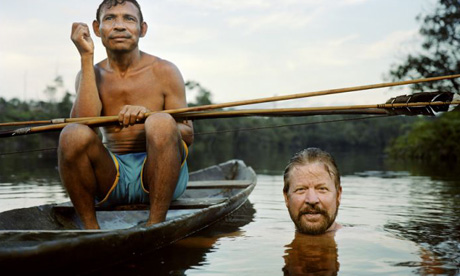 This great photograph accompanies an article in today's Guardian about the ex-missionary and linguist, Daniel Everett, and his experiences with an Amazonian tribe, as a result of which he's had probelms not only with God, and his family, but also with Chomsky. It's a fascinating article, whether you're interested in God or Chomsky - united, if nowhere else, by their notions of universality - and Everett's book looks well worth reading too.
You need to read the article to get the title.
Saturday, 8 November 2008
In the stump of the old tree
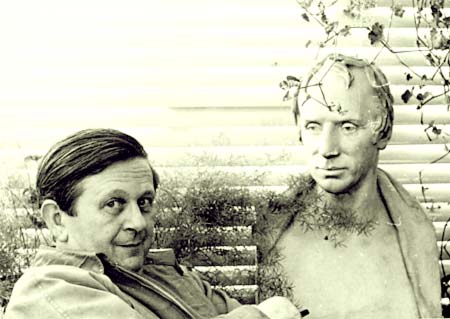
I've just come across a Guardian blogpost by Billy Mills about the pleasure of discovering little-known writers, in which he mentions Hugh Sykes Davies, pictured above in the grounds of St John's, Cambridge, where he taught. Like Billy, I first came across Sykes Davies in the Penguin anthology of Forties poetry, where, as a teenager, I fell in love with his wonderful, creepy poem, beginning In the stump of the old tree...
I haven't thought about him for ages, but the post reminded me that an old GLF acquaintance of mine from my Cambridge days, Derek, Bowie look-alike and famous for having fucked every member of the St John's boat crew (he said), had Sykes Davies as his long essay supervisor. Derek told me all kind of fascinating, often scurrilous details about the man, which to my shame I've forgotten, but I do remember him talking about the massive amount of unpublished material there was and about Sykes Davies' plans to organise it. Or maybe my memory is wrong. Maybe he was planning to destroy it. Having just read this fascinating piece on Sykes Davies, by George Watson, from Jacket Magazine, I suspect the latter to be more likely. But if I'm wrong and there is this work somewhere, it would be very good to have it. In the meantime, here's a taste of the man from Watson's article:
His role model was a cab driver he had once fished with whose previous job had been in a circus, riding a motorbike on the Wall of Death, until he started to have blackouts and had to give it up. ‘You can’t have blackouts on the Wall of Death: besides, I had a lioness in the sidecar.’
Subscribe to:
Posts (Atom)