Showing posts with label nick harkaway. Show all posts

Monday, 2 February 2009

Countdown

Recognise this? Of course you do! It's the front cover of the paperback edition of Little Monsters. It's slightly different from the hardback - my name's now larger and centred (an entirely thrilling development) and Beryl Bainbridge's generous endorsement has been replaced by a quote from the Daily Mail review saying that the book is 'beautifully written, and more compelling than many thrillers', which says something about the book (its aim) and something about marketing (not its aim). This obviously takes nothing away from my joy, which is unbounded, but I just thought I'd mention it. 

The book hits the shops on Friday, 6 February, and on this occasion I'm not indulging in wishful thinking or hyperbole because it actually will be hitting a much larger number of shops than the hardback edition did. This is because Waterstones branches nationwide (including Wolverhampton - I know, I checked) will be including it in their 3 for 2 offer, so the book should be stacked up on tables all over the country, rubbing shoulders with The Gone-Away World - Hi, Nick! (It's 3 for 2, I can afford to be magnanimous) - and all kinds of other great reading experiences. (This is what happens when I slide into promotion mode - my language goes.) And those of you who are travelling in the next few weeks should see even more copies at WH Smith Travel shops in stations and airports throughout the UK, where it will be available in their Buy One Get One Half Price offer. Yes! Naturally, since I won't be there to witness this, I'm looking forward to all your sightings, preferably with photos. So prime your mobiles...

I was going to save this post until Friday, but I couldn't wait. Now I'll have a dreadful sense of hollowness for the next four days. 

PS I wanted to call this post 'Countdown to...' well, something, so I googled 'countdown to' for inspiration and found, to my dismay, that the two most frequent words to follow the phrase, apart from Christmas, which clearly isn't appropriate except metaphorically, are 'extinction' and 'armageddon'. 

Tuesday, 13 January 2009

Coffee and Cronenberg

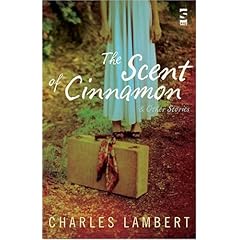
Just over six months ago, I wrote a rather snippy post about the way quality newspapers were as entranced by celebrity as their tabloid counterparts. The post was occasioned by a couple of reviews of first novels written by people who, regardless of their own ability, were also extremely well-connected in the literary world, and I was in a huff about how they got all the attention while poor little me other first novelists didn't. To my surprise, and joy, one of these novelists - Nick Harkaway - got in touch with me that very day to say that he agreed with me. Since then, we've been in touch frequently about all sorts of things, we've almost shared a spaghetti alla carbonara in Rome, I've read and been very impressed by The Gone-Away World (out in paperback on February 5th) and Nick has agreed to interview me on my Something Rich and Strange virtual book tour. You can find the interview here. I have a photograph of Nick holding a copy of The Scent of Cinnamon with a look of disturbingly manic glee on his face - a reaction I hope the book routinely evokes - but I have too much respect for the man, and his reputation, to reproduce it here.

(I'm still waiting to hear from Martin Amis's wife.)

Friday, 22 August 2008

The whole business

It takes a brave man, or woman, to imagine a world that is, and isn’t, the world we live in, that will tell us convincing tales about what we should and shouldn’t do, about how we should and shouldn’t live, without descending into lecture, or ascending towards parable. And it’s interesting that the tales which do this most successfully should so often be considered exercises in genre, as though that meant they had less authority than other sorts of narrative.

Nick Harkaway, in his first novel, The Gone-Away World, provides us with a handle on the world that actually works, that actually opens a sort of window we otherwise wouldn’t have. It does this in a number of ways. In part, by describing a world that we recognize as essentially the world we know, a world in which Tupperware and Star Wars and, er, cake-making remain points of reference; in part by drawing on other richly imagined worlds, or arcane worlds – I’m thinking martial arts, here - as imaginative ballast. He mentions his debt to the great story tellers of the past, from Wodehouse to Dumas in the acknowledgements (and this tells us everything about the range of his style), but much of the strength of the tale comes from its equally firm footing in the dozens of less formal narratives that compose us: education, cooking, friendship, love, not to speak of the popular imagined pre-/post-apocalyptic world of Mad Max and Dr Strangelove. In part because the exuberance and invention and sheer delight of the language is unfailing, with a goon-show-like energy that only occasionally veers into flippancy. In part because Harkaway knows how bruschetta should be pronounced. (Yes, it matters.)

But all this would count for nothing if the novel weren’t also preoccupied with what Harkaway describes as ‘the whole business of how to be a person’. The novel is haunted by alienation, from the early reworking of it in its pure Marxist state (cf. Fingermuffin, capitalist) to the central trope of the novel, which I won’t reveal. It’s concerned with who we are, as individuals and in our relations with others. The core of the novel is a moving recognition of community and how it might survive, against all odds. This seriousness is never far beneath the fun to be had, although there are moments I feel the latter may be overdone. The riff on fashion towards the end of the novel, for example, struck me as heavy-handed, though enjoyable (and then, with an odd swoop, utterly creepy). And there are passages in the second half of the novel, after it’s caught up with itself (you’ll know what I mean when you read it), when the thrust of the story is slowed down by a tendency not to miss a trick in terms of language, when a surface glamour distracts both the teller and the tale. But mostly it’s spot on. A grand job.


And a hard act to follow. I'm looking forward to the next one.

Sunday, 1 June 2008

The son-in-law also rises

Well, I don't know. I've just been to the Guardian site to look at the latest book reviews and what do I find? The first item is Ian McEwan on millennial doomsters. So far, so predictable. I haven't had time to read the piece so I can't comment, though I'm sure McEwan isn't as closely related to the Rapture as I am (read here). The second article is on a début novelist called Nick Harkaway and the third is on another début novelist called Isabel Fonseca. It's wonderful to see space devoted to début novelists, and I'm sure they're both very good. But it would be even more wonderful if Nick Harkaway weren't John Le Carré's son and Isabel Fonseca weren't Martin Amis's wife. I don't doubt that both books have been published on their merits (well, perhaps I do, a little, but I recognise this as sour grapes). But I can think of an awful lot of other début novelists (yes, including me) who would have been more than grateful for this kind of exposure. Billie Holiday had something to say about the mechanism that rewards those who don't really need it, so I'll stop here. But not before I thank Kay Sexton, and John Self, and Dovegreyreader, who did find the time to review me, despite the dismal failure of my immediate family to be famous.