 Forgive my absence. If this blog were a different kind of open book from the one it is, I'd have a lot to tell, but, post-Diana, and unfashionably, I've opted for discretion. Which means that all I'm using it for at the moment is the most fleeting self-promotion. For anyone who'd like to see some translations of the poetry of Jean Genet that I committed, with adolescent hubris, many years ago, I recommend the third number of the always-excellent Cambridge Literary Review, just out, and worth considerably more than the cover price. You can find out more about it here.
Showing posts with label cambridge. Show all posts
Showing posts with label cambridge. Show all posts
Thursday, 17 June 2010
Readings of Genet (mine)
Forgive my absence. If this blog were a different kind of open book from the one it is, I'd have a lot to tell, but, post-Diana, and unfashionably, I've opted for discretion. Which means that all I'm using it for at the moment is the most fleeting self-promotion. For anyone who'd like to see some translations of the poetry of Jean Genet that I committed, with adolescent hubris, many years ago, I recommend the third number of the always-excellent Cambridge Literary Review, just out, and worth considerably more than the cover price. You can find out more about it here.


Thursday, 18 March 2010
dsh, or seduction in lower case
 I've been shamefully absent from this blog recently, but, in partial recompense, here's the chance to read a piece I wrote for the first number of the resurrected Cambridge Literary Review about my memories of the concrete poet and Benedictine monk, Dom Sylvester Houedard, otherwise known as dsh and seen here in priestly garb. This excellent new magazine is putting some of its contents online here, but you'd be much happier if you actually bought a copy and held it in your hands. It's beautifully produced and, of course, contains things that will never see the light of a computer screen.
Monday, 28 September 2009
Me again
 Another self-promoting post, I'm afraid. Here's a two-page glimpse of the first number of the new Cambridge Literary Review, which not only contains this poem, written in 1973, but also a memoir of my meeting with the concrete poet Dom Sylvester Houédard, or dsh, as he preferred to be known. It's shockingly candid, as people used to say when reticence was a virtue. (Click to embiggen.)
If you'd like to know more about this excellent review, the first issue of which is dedicated to Cambridge writing, click here.
Saturday, 8 November 2008
In the stump of the old tree
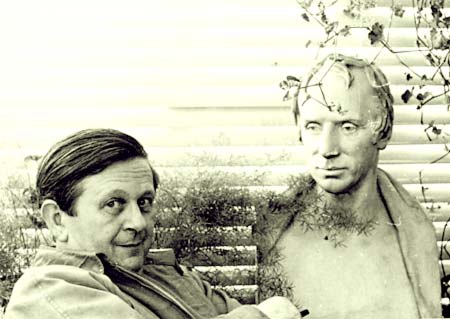
I've just come across a Guardian blogpost by Billy Mills about the pleasure of discovering little-known writers, in which he mentions Hugh Sykes Davies, pictured above in the grounds of St John's, Cambridge, where he taught. Like Billy, I first came across Sykes Davies in the Penguin anthology of Forties poetry, where, as a teenager, I fell in love with his wonderful, creepy poem, beginning In the stump of the old tree...
I haven't thought about him for ages, but the post reminded me that an old GLF acquaintance of mine from my Cambridge days, Derek, Bowie look-alike and famous for having fucked every member of the St John's boat crew (he said), had Sykes Davies as his long essay supervisor. Derek told me all kind of fascinating, often scurrilous details about the man, which to my shame I've forgotten, but I do remember him talking about the massive amount of unpublished material there was and about Sykes Davies' plans to organise it. Or maybe my memory is wrong. Maybe he was planning to destroy it. Having just read this fascinating piece on Sykes Davies, by George Watson, from Jacket Magazine, I suspect the latter to be more likely. But if I'm wrong and there is this work somewhere, it would be very good to have it. In the meantime, here's a taste of the man from Watson's article:
His role model was a cab driver he had once fished with whose previous job had been in a circus, riding a motorbike on the Wall of Death, until he started to have blackouts and had to give it up. ‘You can’t have blackouts on the Wall of Death: besides, I had a lioness in the sidecar.’
Tuesday, 4 November 2008
Derek Brewer
I see from today's Independent that Derek Brewer died a couple of weeks ago, coincidentally on my birthday. He's praised there for being a Chaucerian, as, of course, he was, pre-eminently, but my memories of him come from the summer term of my first year at Emmanuel, when he was my supervisor for Shakespeare. He had a room in East Court, and once a week I would walk across the gardens with Dick Landy for our supervision, always with the faint trepidation of the essentially unprepared and the hope, soon to be dashed, that the heat of Brewer's attention would be directed not at me, but at Dick. That term is pretty much a blur for various reasons, but I have a distinct memory of our supervision on Macbeth. Brewer was in an uncharacteristically gloomy mood that day and, to our relief, seemed less interested in our views of the play than in the suicide of the author and TV presenter Kenneth Allsop. He spoke about the hopelessness and vacuity of middle age, suggesting that both Macbeth and Allsop had fallen prey to it in a way which made it fairly clear to us, callow 19-year-olds though we were, that he saw himself, on that day at least, as similarly afflicted. It was an odd, sobering experience to see him open up - not to us who might as well not have been there - to some darkness, some bitter understanding, in himself. He was 49. I was impressed and disturbed at the time. Now, at 55, I know exactly what he meant and I wonder if it might not have been particularly hard for him, as a Christian, to accept that understanding, which is one that faith can't usefully bolster, and move on.
Monday, 7 April 2008
Andrew Crozier 1943-2008
 Of all the 'Cambridge' poets, Andrew Crozier was the one who touched me most often, and most consistently. Ferry Press was central to the whole enterprise. I loved his intelligence and his eye, and I'm sorry to see him go.
February Evenings
by Andrew Crozier
I begin with a name. It isn't you
profiled against an orange skyline.
Nor the light that dazzled me when I opened a door
and realised after, I don't know how long
I stood there holding on to the doorknob, I faced
due west. It is early morning in March
which is the name of nothing I might hold to
since I can speak only from my temporary place
in the solar system. It is a February evening
the nights are drawing out and I love you
driving your car so attentive to the hazards of traffic
while I observe the passing skyline which so exactly
defines the way your hair falls onto your shoulders
alert to whatever should show up next.
Where were we going? I don't remember arriving
till I enter a room to see the sun setting
framed in the window and know that I still love
while you are elsewhere in its presence there is only
the light it sheds about us as I step into the area
where I can speak your name into a silence
which answers me.
Friday, 16 March 2007
THE GIFT
Time for a little poetry after so much unpleasant and utterly disrespectful ranting. This poem, written 33 years ago, was published in a fugitive collection entitled Of Western Limits, containing my work and poems by John Wilkinson, ostensibly written during a walking holiday we went on in Scotland and intended to be a Lyrical Ballads for our generation. There's certainly a copy in the British Library and there may even be one in the Cambridge University Library. I have one myself, unbound, and I imagine John does too. And that's it. It's dedicated to Charlie Bulbeck, who printed the collection and conspired with its authors in various other undertakings of a cultural nature.
The Gift has apparently been referred to as 'the great lost work of the Cambridge school'. (Once more, I have John to thank for this information.)
Well, it's lost no longer.
for Charlie Bulbeck
Where we drive it is stubborn,
parked on the cliff edge it comes
with dawn. By inclusive reckon
each meed recovers its promise,
drifts home, a treasured account
in the nervous rein. Only a
loose prize, caustic on
the parabolic curve of tin,
burnished, you might reflect,
in whose pervasive ardour.
We are spelt, as grammar and
glamour cohabit in the patch;
a scholar’s trick. We conjure
allotments, ravishing in this
bright arena, with subtle poise
down the borders of light.
From scattered harvest, neap
touches the high-water mark,
rummage of golden oddments
scooped in, the sight of grain.
Forgiven by the bollard, by
the gleaming trim of the hub,
you reap, compacted to your
lunar metric. An occult
precipice and the flank of
achievement is bare, enticing.
It is sleight of hand, the boy
looks open mouthed as the conjurer
cuts down the stalk, a white bird
shimmering on his sleeve.
And this is the gift it brings:
refracted on the car, in sight
of the coastal acres, scoured
haloes of sunlight ‘as solid
and dense and fixed’ as
you can hope to secure it.
Arrest that flame, coals glint
and the flue is absolved by this
shiny token it palms you, tanned
still, elated in the fluent breeze.
The Gift has apparently been referred to as 'the great lost work of the Cambridge school'. (Once more, I have John to thank for this information.)
Well, it's lost no longer.
THE GIFT
for Charlie Bulbeck
Where we drive it is stubborn,
parked on the cliff edge it comes
with dawn. By inclusive reckon
each meed recovers its promise,
drifts home, a treasured account
in the nervous rein. Only a
loose prize, caustic on
the parabolic curve of tin,
burnished, you might reflect,
in whose pervasive ardour.
We are spelt, as grammar and
glamour cohabit in the patch;
a scholar’s trick. We conjure
allotments, ravishing in this
bright arena, with subtle poise
down the borders of light.
From scattered harvest, neap
touches the high-water mark,
rummage of golden oddments
scooped in, the sight of grain.
Forgiven by the bollard, by
the gleaming trim of the hub,
you reap, compacted to your
lunar metric. An occult
precipice and the flank of
achievement is bare, enticing.
It is sleight of hand, the boy
looks open mouthed as the conjurer
cuts down the stalk, a white bird
shimmering on his sleeve.
And this is the gift it brings:
refracted on the car, in sight
of the coastal acres, scoured
haloes of sunlight ‘as solid
and dense and fixed’ as
you can hope to secure it.
Arrest that flame, coals glint
and the flue is absolved by this
shiny token it palms you, tanned
still, elated in the fluent breeze.
Thursday, 25 January 2007
HEROES
This was first published in Angel Exhaust Ten, edited by Andrew Duncan, its publication solicited, I believe, by John Wilkinson, for which much thanks. It's an interesting (I hope) hybrid of the Cambridge School and large doses of Lorca. I don't know if the magazine is still available, but, just in case, here it is. It's part of a large group of poems that have never been published, entitled VALUE.
HEROES
‘A walled dream in which I am stupidor a bullfighter’
R.F. Walker
1
He wants to make it more perfect.
The beaker belongs in his hand and a golden
armpit over his mouth can’t stop their
vicious whispers for more than a beat.
He is living in the surf.
The music belongs to them that
his feet will dance from, scared
to find himself
the dancer in their despite.
No one has told him off for a thousand years.
How does he know what to do?
He began by counting the waves
that rising now will engulf him
and he knows their numbers as beads of white
or as the scattering of white birds,
numbers revealing his pitiful age.
That pleasure is his for a moment
and the bending of a suddenly prolonged
lightning toward his feet, which burn.
When one day he will count ten fingers
on both his hands, and know himself whole.
2
And then he will be noticed,
everyone moving harmoniously
round the green walls of his harbour
which is all commotion.
Breaking days,
to celebrate the departure of calm
as a breach in the climate, are pinkly
vacant. And he is happy
to be lost among friends, whose concern
is the delicate frill of his suit.
He gathers them up as fruit in his gloves.
3
He is the work of his own dismayed genius.
An amphora found in the city after
excavation crumbles into dust, his mother’s
arm. To the applause of crowds
he runs through the dance that will
fire their alien tribunes, who scrape and bow.
His charm is to be foolish as they are
foolish, with his wrists in a bowl of acid.
They have come so far for nothing but his smile
they can barely see in the earthbound light
what children they are. Those he has banished
gather in their nets
while a red tongue licks from a cloud.
These have been spared, in the great
waves they are crushed to infinite sand.
He raises a finger and a new music is born.
An acrobat turns on the stars to scream.
4
Let blood. Peel off his nipples,
starfish. The philosophic jaw
swings over his tranquil harbour,
midges on its slowly-dissolving
yellow screen. Not soft enough
to be wrought as the landing-stage
sets up a film he saw years ago
in the bright arena, and bled.
He cannot bear that flatulent music.
5
His love has become grenades in the arms of girls.
They take him by the nose through mirrors
that mistake the word ‘ghetto’ for ‘grotto’.
Under the rain he makes sisters out of flowers and owls.
The house is sliding. Where is the house?
He is walking uphill between sofas and trays of cachous.
He is a black man making good.
He is searching for strangers of his own kind.
Glass-like, they wait by his raised eye
for kisses and a basket of
wounded hair. The girls explode.
6
Alone now, he presses his thumb
against the neck of the vase.
He rests an ear on the stalk of its green throat.
Casually spread with gold
the evening dips in his throat
a violent rod, the engine of desire just
turning over as it probes, its stations
revolving as echoes in the machine.
Goldenrod. Love. The break of the lights
on the turrets, swinging his way.
He pauses for the applause of guns
to fathom his silence. He looks like
winning when a breach appears in the smoke,
his seventh labour
barely begun. A little wound.
7
He is wearing that horrible light
that is love for others. Windily showing
his disregard he sloughs it off as
symptom of a gilt and whore-like age.
Glistening in what darkness becomes him
now and as though at rest
in the colonnade of his bones a dog barks
to be put to sleep. They dance in each other’s eyes,
ten boys with the gestures of one, a curtain
straining to be closed.
If anyone answers he is lost,
beginning to die for the others.
In a palmful of water his velvet cries
are expanding always
expanding into muscle.
8
The weight of his sinews is covered in fur,
hysterical and white as a fountain.
A snowman. Kissing its scandalous mouth
he is gifted with the gift of words
to cord his thighs, to make lifting a bird
in the lightning, to silence the clouds,
to tell him what he wants to hear,
the numeracy of the bone structure,
the bees in the throat chamber making music,
dresses that heal the sadly distended armies,
the dream that occurs as a junction box
to re-route the seasons into his mouth.
9
Blue smoke that bears no repetition,
that stutters its cloud-like past
within the bell, the clamour of its wanting
waking the man. He is a statue
under the watery feet of Goths,
he is a heart of legendary blackness,
he is a vein
that runs from that heart
towards a singing and vacant history
of the self among roses and storks
tattooed on a chest, he is a dragon
mounting a girl, he is a girl, he is a clock
dismembered by horses in Paris in the rain,
he is a table made of flesh
in an empty house by a lake,
his filth and compromise
the breaking of love against a coast
suddenly there, its whiteness
and the fluted numbers.
Thus he’s divided
into cards and their numerous arrangements for death
around a central point, where he is perfect
as the decorative art of his veins shall become.
Subscribe to:
Posts (Atom)