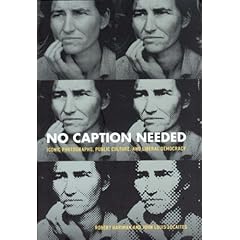
I was reading a review in a recent London Review of Books (Vol 29, No 23) of a book called No Caption Needed: Iconic Photographs, Public Culture and Liberal Democracy, by Robert Hariman and John Louis Lacaites. The book, as you've probably guessed from the title, talks of the process by which photographs come to represent not only the specific moment at which they are taken but something much larger; become icons, in other words. The review, by David Simpson, cites the famous photograph of the Vietnamese chief of police shooting a Vietcong suspect in the head, and the way it subsequently came to stand for everything that was wrong with that war. Later in the article, it mentions the photograph of the napalmed girl, which no one who has seen is likely to forget.
But it also makes an interesting comment about the way the image that is selected to act as this kind of resonant shorthand reflects not only the actual event - a dying man, a burning girl - but also the way we choose to see it. The example the book (and review) providesis that of the single student facing down the tanks in Tienenman Square. As an event, Tienenman Square was a triumph (and remains so, despite its suppression) not of individualism but of collectivism. It was a triumph of numbers. Yet we've allowed, or preferred, the single image that represents the event to celebrate an act of single heroism. This is perfectly in line with western 'liberal' notions of resistance, but it's an incongruous and even offensive way of commemorating what went on. It's foisting our sense of what matters onto people for whom that sense might be inimical.
Most potent images are of individuals. Dorothea Lange's migrant mother, the Iwo Jima flag, most recently the falling man. Perhaps the only event which seems to have resisted our need to focus on, and celebrate, the particular is the Holocaust. The photographs of the Holocaust that haunt us don't show individuals, but heaps of bodies that are barely recognisable as human, let alone people with quirks and desires and claims being made and histories. They starved to death, but that isn't what reduced them to this. It isn't that starvation can't be done at an individual level; I'll never forget the face, or body, of a man photographed in Srebenica.
It must be that we don't want - or are unequipped - to see the event in those terms, in terms of the single emblematic life. We see them en masse. And I don't know if this is a good thing - because the Holocaust can never finally be understood and to see it in terms of individuals would be, in some terrible sense, a sort of trivialisation - or a bad thing - because we think in numbers and the weight of numbers, and numbers are an avoidance strategy.
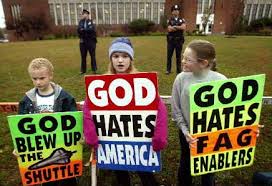 I've heard people say that the Westboro Baptist Church, by revealing the true face of fundamentalist homophobia, is the best thing to happen to the fight for gay equality in years. I suppose this is true in the same way that summary executions of teenage gays in Iran or the anathema of Mugabe and the president of the Gambia, whose name I have no intention of committing to memory, are 'useful' reminders of the lengths to which instutionalised homophobia can go. By this token, Ratzinger's decision to welcome back to the catholic fold a gang of befrocked negationists, otherwise known as the schismatic followers of French archbishop Lefebvre, can also be seen as a good thing as it strips away yet one more layer of whatever moral
 authority the man, and the organisation he represents, is supposed to possess, though it must be rather hard on those catholics who belong to the church because they believe in the message of Christ. The next thing you know he'll be recognising the authenticity of the Protocols of Zion. Why shouldn't he? Holocaust-denier archbishop Robert Williamson already does.