Showing posts with label gay. Show all posts

Monday, 26 September 2011

Lists

A couple of days ago a site called listaouting published the first of a series of promised lists. The list contains the names of ten Italian politicians who have voted consistently in favour of anti-gay legislation, despite being, according to the people who've put the list together, gay themselves. The idea behind the list is that the ten politicians deserve to be outed not as gays, which is nobody's business but theirs, but as hypocrites. It's not a difficult concept to grasp. When a bunch of right-wing politicians here in Italy organised an event called Family Day, with the aim of defending the traditional family (sic) against the destructive and disordered forces of civil unions, a number of journalists published the marital escapades of the event's promoters - most of whom had been divorced at least once, and many of whom were currently living with their partners, unmarried or in sin, as we used to say, in blithe indifference to the rules of the Catholic church to which they all, at least nominally, belonged. They weren't being exposed as divorcees or adulterers but, once again, as hypocrites. Nobody seemed to feel that this offended their human rights. People who say one thing and do another, in that case at least, were seen quite rightly as fair game. No magistrate investigated the publication of their names or suggested that some heinous crime had been committed. Nobody talked about defamation, or presumed that the journalists in question suffered some form of mental illness. Nobody talked about media lynching or the need to protect individual privacy. These men, with their talk of the sanctity of the family and their strings of ex-wives and illegitimate children, were politicians. Being exposed as phonies was one of the risks that went with the job. The church, to which all paid lip-service, didn't seem to mind, after all. So why should they?

So it's interesting to see how differently people have reacted to the publication of this list. It should be said at once that the list offers names, but no proof, but that's hardly surprising. What would constitute proof of gayness, other than a statement from the person in question or a compromising photograph? (Or a wire-tapped conversation? In the land of tapping, I live in hope.) The former ain't going to happen; the latter is likelier, and would certainly be more fun. So we can ignore the whole business or take the list on trust. Certainly, the reaction of the blogosphere seems to confirm the claims. Maurizio Gasparri, Berlusconi henchman and not the sharpest knife in the box, appears to be known as Culetto d'Oro (Golden Botty!). Roberto Formigoni, governor of Lombardy and leader of the cattolicissimo Comunione e Liberazione, an organisation that has sewn up more tenders for its members than I've had hot dinners, is rumoured to have had a quickie with George Clooney. Lucky Roberto. Gianni Letta, the power behind Berlusconi's throne, if that isn't too dignified a term for it, has had so many face-lifts he makes his boss look rugged. Roberto Calderoli, the charmer in the photograph and Minister for Simplification - something he does whenever he opens his lovely mouth - is the kind of man who keeps wild animals in his garden and wears T-shirts with Viva la Gnocca (Long Live Cunt!) written on them. If further proof is needed, it can, apparently, be provided. Paolo Bonaiuti, Berlusconi's well-oiled spokesman, is also on the list, as is Ferdinando Adornato, who started out as a left-wing intellectual and is now neither left-wing nor intellectual. Then there's Luca Volontè, also cattolicissimo and fetchingly jug-eared, who has stated that 'the founders of modern psychology describe homosexuality as a clinical pathology'. On the grounds that the lady doth protest too much, along with a whiff of the 'no smoke without fire' defence, I rest my case.

And, in one sense, the fact that they're gay or not is irrelevant. Because what's shocked me about the whole business is not the reaction of the people on the list. They've been lying (or refusing to answer questions deemed embarrassing )  for decades - why on earth should we believe them now? It's the reaction of others that worries me. Mara Carfagna, ex calendar girl and now government minister (and an old favourite of this blog), has talked about a 'defamatory attack'. Defamatory? In whose eyes? It's good to know that Ms Carfagna, whose mandate is to ensure equality of opportunity, considers an 'accusation' of homosexuality to be defaming. She isn't the only one. If I could have a quickie with George Clooney (just saying, Roberto) for all the people - on the left and right of the spectrum - who've talked about unwarranted invasion of privacy and the need to separate the political and the personal, and all this hogwash that's being used to swill away the central point - that the political actions of these men interferes directly and constantly with the private lives of others - well, George and I would be pretty much fucked out by now. Good night, George.

The worst offenders are, guess who? That's right, Italy's gay organisations. I won't list them here - they aren't worth it - but to hear them talk about the outing of homophobic legislators as though children were being thrown to the lions is the most sickening thing of all. Whose rights are they supposed to be protecting? The rights of men who deprive me of my rights? Of course people have a right not to come out, if they think it might harm them, sad though this is - I'd be the last person, for example, to defend a list of gay footballers (much as I'd like to see it). But that right simply doesn't exist when those same people, for the lowest and most squalid of of motives, use their power to cancel the basic human rights of others. The squirming sanctimonious behaviour of Italy's gay spokespersons as they fall over themselves to defend the hypocrisy of their masters is further proof that Italy remains a profoundly authoritarian country, terrified of raising its voice against the powerful, constantly in search of a crumb from the table, grubbing for scraps of advancement, ultimately behaving itself because it's only through submission to the dominant culture that privileges can be won. It's a lickspittle reaction and the people who represent the public face of gay Italy should be ashamed of themselves.

There are, thank God, exceptions. For those of you read Italian, here's a piece by Aldo Busi.

Tuesday, 13 April 2010

Foot and mouth disease

I've been on the point of writing something about the whole paedophile scandal for a couple of weeks now, but really, why bother? The Vatican is doing such a good job of shooting itself in the foot - yes, that's right, the one it's managed to jam into its own mouth - that additional comment from me seems superfluous. Let them get on with it, say I. Ratzinger and his gang of frocked deniers have managed to anger just about everyone and mollify no one so far, something I'd never have dreamed of achieving with my own humble sniping from my own very small rooftop 100 miles away from Ground Control by the Tiber.

So I'm not even going to comment on the latest nonsense from a certain Cardinal Tarcisio Bertone (seen here with friends), who claims that a clear link has been found between paedophilia and homosexuality but not between paedophilia and celibacy (except perhaps to point out that if you're celibate, darling, you're not having sex with anyone). In fact, the only clear link I can find in this whole sad business is the one between a bunch of frightened old men whose authority is being challenged and the spouting of malicious bullshit.

And that's not a comment. That's science.

Monday, 7 September 2009

Mud, to be worn with pride

Last Friday, Dino Boffo, the editor of the Catholic newspaper, Avvenire, decided to resign after having been attacked and accused of hypocrisy by one of Berlusconi's house rags (Il Giornale, owned by his brother). The Vatican accused Il Giornale of an aggression it considered disgusting, vile, indefensible, etc. As did the opposition, the opposition press, and pretty much everyone not on the Grand Buffoon's payroll. Great fun, and it's hard not to be happy to see the blood flowing from Berlusconi's foot while the gun's still smoking in his hand. But hypocrisy is hardly a hanging issue in Italy. The dreadful stigma that's destroyed Boffo's career, family life, mental health, public probity, and so on, and merrily reduced him to the state of Dreyfus on his way to Devil's Island, the mud that's stuck to his face and hands and keyboard, the sin that is so beyond the pale that it can definitively shit on the man and his professional future, is not that he's a hypocrite. Good god, he worked for the Vatican! Of course, he's a hypocrite.The problem is that he's been accused of being gay. Because in liberal, 21st century Italy, being gay is THAT bad. Get used to it, boys and girls. And get used to the fact that practically no one, in all the outrage this spat produced, and with all the anathema discharged left, right and centre, had the - what shall I say? - political sensitivity to remark on this. It's no surprise that some deranged heroin addict who calls himself Svastichella (hiding behind a sheet of paper, above) should be stabbing gay men in the country's capital because he finds them upsetting, or offensive, or potentially damaging to the morals of a twelve-year-old who wasn't there.

Saturday, 28 March 2009

A crate for fruit


Update: If anyone thinks this is a gratuitous slur on the Pontifex and his sexual preferences and doesn't speak Italian, the slur is actually worse than they may have thought. The name of the wholesale fruit and veg dealers on the side of the plastic crate in the top picture is PAPA & L'AMANTE (which, translated into English, reads POPE AND LOVER). Papa is a fairly common name in these parts, L'Amante rather less so; the combination was too good to miss.

Saturday, 17 January 2009

March for Equality

If you're on Facebook and think that equality matters (these categories don't, alas, always coincide), you might like to take part in the Online March for Equality. All you need to do is go to this site and choose an image to replace your profile picture for the next few days. It's a simple procedure and you don't even have to leave your desk, but that doesn't, I hope, make it entirely useless. Of course, if you're anywhere near the actual inauguration and can actually march that would be even better.

Friday, 12 December 2008

Everything I Have is Blue

I've just finished reading the anthology Everything I Have is Blue (helpfully subtitled: Short Fiction by Working-class Men about More-or-less Gay Life). It's edited by Wendell Ricketts, who also contributes a gripping short story of his own and a final, finely written and thought-provoking essay. With the exception of Wendell himself and one of my favourite writers, Keith Banner, most of these writers are new to me, although I have come across CAConrad on various networking sites and enjoyed what I've seen of his work. This doesn't mean they haven't published; most of them have rich and varied writing careers, described at the back of the book. It's more likely to mean that the kind of writing they're involved in is marginalised. Marginalised initially as gay writing and, subsequently, in class terms as writing that appears to fail to tell us what we want to know: that we're young, beautiful, rich and infinitely desirable. I've been thinking a lot recently about the non-consolatory function that gay writing might perform, mostly in the context of my virtual tour for my own short stories, and so it's exciting to see how this immensely varied group of writers work with their material to talk about lives that are demonstrably less than perfect, by which I mean recognisable as human.

My favourite pieces in the collection are probably those that work at the interface of gay-straight lives, such as the opening story by C. Bard Cole or Marcel Devons' tale about Scotty taking his boyfriend home to meet his parents. More than any other, I loved My Special Friend by Christopher Lord, and not only because the reading of it coincided with a dispute about Christmas trees chez moi. I found the final story in the collection, a long piece by James Barr, interesting as a story and even more interesting in a socio-historical sense; for me, at least, it illuminated the background to Brokeback Mountain, which must be the most famous story ever written about working-class gay men, while offering a sort of alternative to that story's historical hopelessness. It's the nearest story in the book to what I've termed consolatory, but even here the hero's forced, through one of those timely accidents fiction depends on, to think about, and come to terms with, his sexual and emotional needs.

What's refreshing about the book as a whole, though, is that it offers not only scenes of deprivation and desperation, but also possibilities of happiness that aren't shallow, self-defeating or unattainable, and it does this with warmth, intelligence and skill. I'm least happy with the stories in which a sort of poetic take on lives of hardship and squalor seems to glamourise rather than portray those lives, a stance that comes across, to me anyway, as inverted consolation. I'd also say that the sub-culture depicted in, for example, Skins, powerfully evoked though it is, isn't working-class at all, but sub-proletariat and as ghetto-ized in its way as the flashier world of 'beach reading'. But what the book does, to its enormous credit, is foreground these issues, and it does so by bringing together some fine and exciting writing. You can click on the link above to order the book, read more work by other great writers and contribute to Wendell's ongoing project. You won't regret it.

Saturday, 6 December 2008

Thursday, 4 December 2008

Questionnaire

  • What do you think caused your heterosexuality?
  • When and how did you decide you were a heterosexual?
  • Is it possible that your heterosexuality is just a phase you may grow out of?
  • Is it possible that your heterosexuality stems from a neurotic fear of others of the same sex?
  • Do your parents know that you are straight? Do your friends and/or roommate(s) know? How did they react?
  • Why do you insist on flaunting your heterosexuality? Can't you just be who you are and keep it quiet?
  • Why do heterosexuals feel compelled to seduce others into their lifestyles?
  • A disproportionate majority of child molesters are heterosexual. So you consider it safe to expose children to heterosexual teachers?
  • With all the societal support marriage receives, the divorce rate is spiraling. Why are there so few stable relationships among heterosexuals?
  • Statistics show that lesbians have the lowest incidence of sexually transmitted diseases. Is it really safe for a woman to maintain a heterosexual lifestyle and run the risk of disease and pregnancy?
  • Considering the menace of overpopulation, how could the human race survive if everyone were heterosexual?
  • Would you want your child to be heterosexual, knowing the problems that s/he would face?
If you'd like to know more about this questionnaire, click here. From Joe.My.God. 

Tuesday, 17 June 2008

From A to B, via C, is just so gay

According to some new research, although I feel I've read it all before, gay men and straight women can't navigate, while lesbian and straight men can. This is due to the relative proportions of the left and right hemispheres of their brains. I don't have time to get mine scanned, however tempting the prospect is, so I can't check, but I do know that I have an almost unerring sense of direction, which would make me a lesbian or a straight man, and no inclination at all to have sex with women, which wouldn't. My partner, on the other hand, bless his cotton socks, would get lost in a glass of water, as we say in Italy, which tends to confirm the research.

Is there something wrong with me? Will I wake up one morning and not know my left from my right, and need a map to find the local supermarket, and walk out of shops and turn back in the direction I came from and end up standing on a vaguely familiar corner wondering where the hell I am? Or will I just buy the latest Mara Carfagna calender and drool over those ministerial curves? Maybe some minor brain surgery can be performed, to slightly deflate my right hemisphere. Or maybe, just maybe, the research isn't quite as watertight as it would like to be. I wonder if Ben Goldacre's Bad Science will have anything to say about this... I wonder which way is up...

Sunday, 11 May 2008

Ministerium

Mara Carfagna is Minister for Equal Opportunities in Berlusconi's new cabinet. This poster comes from an earlier incarnation as calendar fodder and, oddly, wasn't used to promote her campaign during the recent elections. Possibly because Italian voters aren't actually allowed to choose their representatives, but only the party to which they belong. In the lovely Mara's case, the Popolo delle Libertà, otherwise known as Poppe al Vento (Boobs to the Wind). I wonder what Gianni Alemanno, Rome's new mayor, thinks about this sort of exhibitionism.

Carfagna announced last year that gay unions shouldn't be recognised because 'homosexuals are constitutionally sterile.' No one is quite sure what this means, but it certainly feels offensive.

Monday, 31 March 2008

Jonathan Williams

I first met Jonathan Williams when he came to Cambridge to read for Blue Room, a poetry society founded by John Wilkinson and run by John, his old school-friend Charlie Bulbeck and the more recently co-opted me. I had the grand title of Blue Room Secretary and was responsible for, among other things, booking rooms in my college for the reading and the guest poet. On this occasion we had two guest poets because Jonathan came with his partner, Tom Meyer. I don’t remember if we were unaware of this and booked, as usual, a single room, or were aware of it but thought, as young people tend to do, that one small bed would be enough for the two of them. It may even have been the case that the college didn’t offer a double room on the grounds that women weren’t allowed to sleep within its walls. Jonathan took one look at the bed and said to Tom: ‘Well, you’ll have to find somewhere else to sleep tonight,’ in a tone that struck me as playful but, thrillingly for me, not ironic. Tom was no taller than I was, bottle-blond (though I didn’t know this then), finely built and featured, a fragile adjunct to the solider, bearded, avuncular figure of Jonathan. They’d arrived the morning before the reading and had offered to drive us to a restaurant outside Cambridge for an early dinner that evening. I don’t know whose idea it was to take them to eat kebabs for lunch at the Gardenia, a basement café just off Trinity Lane that’s recently been saved from closure by, among others, Stephen Fry, but it wasn’t a success. I remember Jonathan peering into his pita with a forlorn expression and muttering, ‘Hmm, street food.’

Later that day, Jonathan and Tom drove John and me – Charlie having bunked off by this point – out of Cambridge to a pub that was famous at the time for its irascible owner, his taste for Wagner played loud, and his accommodating, brow-beaten German boyfriend. We drank Adnam’s ale – we had no choice. This was followed by a hotel restaurant that Jonathan had heard, or read, about and wanted to try. Jonathan cared about food in a way that’s utterly normal now but, in late 1973, seemed both luxuriously decadent and pedantic, an attractive though somewhat forbidding mix. I have no memory of what we ate. What I remember is the rather meandering ride home and the way I managed to slump against Tom in the back of the car, my thigh idly – would-be indifferently – pushed against his.

The reading was attended by the usual small group of enthusiasts, but I was too taken by the physical memory of Tom’s leg against mine to be more than summarily aware of what was read; I was also drunk. At the interval, it being my job to make coffee, I darted from the room to fill my kettle and bumped into a friend – Paul Johnstone, now dead – who asked me how the event was going. I think I’m sleeping with Tom tonight, I told him, unaware that every word was heard in the room behind me, where the poets and their audience were seated. John told me later, the following day, that Jonathan had raised an eyebrow but was otherwise pokerfaced. I have no idea how Tom reacted.

The post-reading party was in my room. By this time, I’d been told about my gaffe but, stubborn and optimistic with alcohol, remained undeterred. Half an hour into the party, when Jonathan left, I was sitting in my armchair, with Tom on the floor in front of me, his shoulders between my knees. ‘I’ll see you boys tomorrow,’ Jonathan said, and I imagine Tom nodded and smiled, perhaps wryly, as I did not, not believing my luck. To understand how much in love I was with the man whose head was almost, almost against my groin, you would have to factor in so much that isn’t needed here, where what I want to do above all is to talk about Jonathan’s generosity. The rest of the party faded away quite rapidly after Jonathan’s departure and suddenly Tom and I were alone. ‘Shall I make some coffee?’ I said, and Tom said: ‘Coffee?’ in a way that made me feel both foolish and desired. Five minutes later, he was twisting peach-coloured toilet paper around his contact lenses while I, like a bride, prepared for bed.

They left the next day. We walked with them to the brand-new multi-storey car-park where they’d left the car, talking about Joseph Needham and China, or Ronald Johnson, or Thomas A. Clark, a friend of John’s who’d recently been published by Jargon. Jonathan gave us their address, invited us to visit them in their cottage in Cumbria. As the car pulled off I felt that the end of some essential organ in my body had been attached to their bumper and was slowly, smoothly unspooling. I didn’t know who I was, nor where; with what was left to wave goodbye or with what had been drawn out, away, and gathered up, like wool, by what had happened. Thirty-six hours later, having made up my mind that I could never just go on with my life as it was, which now seemed as false and hollow as I’d become, I was on the road for Dentdale.

There was snow, and the last lift dropped me some way from the house. I must have called from a rural phone-box because Jonathan came in his car to collect me. I can’t remember now if I’d let them know that I was coming or, fearful of rejection, had simply presented myself as near as damn-it to the house, giving them no choice other than to take me in.

Tom had a cold. He didn’t seem pleased to see me, or not pleased; I wasn’t certain he knew who I was, although that, surely, was impossible after only two days. More than anything, I imagine now, he must have been uncomfortable, perhaps even peeved. He’d had no idea what he’d mean to me when he chose the easy option of my room, more for Jonathan’s comfort than for his own, as if I were the by-product of his own generosity towards his partner. He’d never considered that I might think I’d fallen in love with him, his New York past, his neck. He cooked for us while Jonathan showed me round, my head a whirl of names: Kitaj, Ginsberg, Hockney, Bunting, but soon after eating he went to bed. Alone with Jonathan, in the part of the house they worked in, filled with books and records, each desk with its own electric typewriter, I wondered what would happen. Jonathan asked if I’d ever had a sauna. I hadn’t.

In the sauna, outside the house, we talked about my life, my future. It hadn’t occurred to me until we were both naked and aching with the heat that I might want to have sex with Jonathan – I was, after all, in love with Tom! – but it seemed entirely natural, and right, that after the sauna and a glass or two of single malt we should go to my bedroom, a small room with walls painted burnt orange next to the room in which Jonathan and Tom normally slept. It hadn’t occurred to me, either, how scared I was of what I’d done, and was about to do, until I was lying on top of Jonathan and snivelling into the hairs of his chest. Jonathan stroked my back, then scratched it gently. ‘You like that, don’t you?’ he whispered. ‘Yes,’ I said. ‘You’re a brave boy,’ he said. ‘Am I?’ I said.

The next day Jonathan called the City Lights bookstore in San Francisco and arranged a job for me. I can’t afford the fare, I told him, but Jonathan smiled and said that didn’t matter; he’d pay for my ticket. That evening, Tom still in bed with flu, he drove me down to the local pub. Jonathan was a local celebrity – I imagine he was always that – and the people he introduced me to, bank managers, store owners, family doctors, treated me with a mixture of respect and contempt I’d never experienced before; respect for Jonathan tinged with contempt for me. It was understood that I’d become a protégé. Someone, cattily, wanted to know where Tom was. By the time we were back at the cottage and it was clear that, this evening, I’d sleep alone, I knew that I didn’t want to go to San Francisco at all. I wanted to pick up my own life once again and make it fit. Jonathan, to his credit, understood.

***

We wrote to each other a number of times afterwards and only lost touch when I really did leave Cambridge, at the appropriate time, with a degree, but I never saw Jonathan – or Tom – again. In his letters, Jonathan gently upbraided me for what he must have seen as a failure of will, hoping that I’d found my ‘Firbankian’ pleasures on the banks of the Cam. I’ve never felt Firbankian in my life, but I was certainly as ill-equipped for life as Firbank had been, and it’s to Jonathan’s credit that he gave me the chance to risk a little and then retreat. He was generous with his time, and his body, a difficult man, superb in the Italian sense of not brooking mediocrity, with that pinch of arrogance that all snobs need to survive. I’ve never regretted my weekend at Dentdale. My only regret is that it was never repeated, and now, that it never will be.

Monday, 24 March 2008

Tuesday, 11 March 2008

Village police

This photograph doesn't even begin to capture the extent to which these two policemen, photographed in Sausalito, looked like refugees from one of those films with titles like Cop Shack or Hole Patrol.

Maybe they were between shots.

Wednesday, 5 March 2008

Life saver

This lifebelt was spotted in a shop window in Sausalito. It's hard to imagine a ship called Nellie, though less hard to imagine those who sail on her referring to one another with the term, which I'd previously assumed was only British. It's heart-warming to find it a spit from San Francisco, less Querelle of Brest than Poofter of Portsmouth, and all the better for it.

Monday, 31 December 2007

A creative spring

In his Terminal note to Maurice, EM Forster writes that the novel was the direct result of a visit in 1913 to the 'socialist and Whitmannic poet' Edward Carpenter at Millthorpe. Forster comments:

I
t must have been on my second or third visit to the shrine that the spark was kindled and he and his comrade George Merrill combined to make a profound impression on me and to touch a creative spring. George Merrill also touched my backside - gently and just above the buttocks. I believe he touched most people's. The sensation was unusual and I still remember it, as I remember the position of a long vanished tooth. It was as much psychological as physical. It seemed to go straight through the small of my back into my ideas, without involving my thoughts. If it really did this, it would have acted in strict accordance with carpenter's yogified mysticism, and would prove that at that precise moment I had conceived.

I was reminded of this scene when I met the author of Akenfield, Ronald Blythe, in Aldeburgh. I'd learnt earlier that day that he used to come to Aldeburgh to shop with Forster so my first thought was something along the lines of diachronic degrees of separation. Only four between me and Whitman, I calculated, and this is where my memory or myth-making tendencies - what my mother called 'romancing' - played me false. Because I was convinced, first, that it was Carpenter himself, not Merrill, who'd laid hands on Morgan's backside and, second, that Carpenter had been blessed in similar fashion by Walt Whitman. At which point. Morgan's creative stroking of Blythe's bum was a foregone conclusion and all that was missing was Blythe's own fair hand on my own fair small of back. I wouldn't say I took the position, in the manner of a beta male orang-utan, though I do admit to a momentary flirt with the Suffolk historian and baton-holder, in my eyes, in the greatest race. Well, my bum went unrewarded, but I did get a warm palm pressed against mine and a whispered, Thank you, my darling boy. It will do.

Sunday, 30 December 2007

Words are also actions

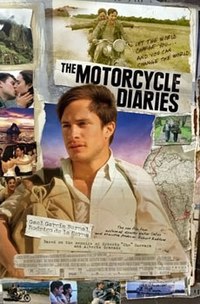
I saw two films on TV over Christmas that touched me deeply, in different ways. The first was The Motorcycle Diaries by Walter Salles, based on the journals kept by Che Guevara and his friend Alberto Granado during a life-changing epic motorcycle ride round South America. It's a directorial tour de force, drawing on genres for what they can offer, discarding them when they no longer serve the purpose. It's not a buddy movie, however much the film examines the changing relationship between the two friends, their affections, their differences - both emotional and political. It's not a road movie, despite the essentially picaresque narrative structure: this happens, that happens, they move on, they meet new people, they fall in love and out of it. What makes it more than a collection of episodes is the cumulative effect the episodes have on the two main characters, particularly Ernesto, a sensitive asthmatic who can't tell a lie for the life of him, or anyone else. The clearest signs of the ruthlessness that enabled him to become the Che of legend are when he simply can't not tell the truth, however painful to others, and to himself, it might be; it's a feature of revolutionaries that the individual sensibility can be sacrificed for the larger notion, and it's to the credit of the wonderful Gael Garcia Bernal that he makes this seem an entirely admirable characteristic.

Quite by chance, I saw Papillon a few weeks ago, for the first time in over thirty years, and it's interesting to compare how the two films dealt with leprosy. In Papillon, the lepers are not only people with a problem, but also - if not primarily - a testing ground for the hero's courage. For this to work, the head leper is suitably monstrous. In The Motorcycle Diaries, on the other hand, the le
pers are seen as an opportunity for compassion, and solidarity. (Interestingly, both films see nuns as hypocrites). What the film left me with was a sense that one life can change many lives and that the quality - and consequence - of those changes might be utterly unpredictable, but that maybe we shouldn't be put off by this. Maybe there is a case for the kind of struggle Che continues to represent. Perhaps the real hero, though, was Che's friend, who set up the Santiago Medical School (I think), creating the one thing for which Cuba can wholeheartedly and unreservedly be praised, and that might never have existed without the work of Che and Castro.

The other film was The History Boys, based on the Alan Bennett play, with the extraordinary Richard Griffiths as Mr Hector, the 'general studies' teacher, preparing a group of sixth-formers for Oxbridge entrance in the early 1980s. Hector's a charismatic teacher but of a curiously low-key sort, as far removed from the character portrayed by Robin Williams in The Dead Poet's Society as is humanly possible.It's always interesting to me to see how much most genuine teachers loathe DPS and how much it's adored by students (in Italy, at least). It's as though teachers recognise how easily the kind of power Williams portrays can be misused and understand that it is, essentially, no different from that of his less hip colleagues. He's still just telling people how to behave. Which, of course, is exactly what students want: to be told what to do by someone who seems to be providing some kind of cool alternative, both to the other teachers and to what the world has to offer. What makes Hector such a wonderful creation is the extreme modesty of his tyranny (he is not, after all, a facilitator). To all intents and purposes, he lets his boys get on with it, as they improvise scenes in a French brothel or act out the final scene from Brief Encounter. They're fond of him, more than they realise, but not enchanted, which is as it should be; enchantment is the last thing a teacher should be up to.

The other theme of the film, of course, is what we do with being gay. Hector is gay, as is Irwin, the new-broom-sweeping-clean teacher and one or two, maybe three of the boys, which made me wonder, with some regret, why my own school days should have been so resolutely straight. I found Hector's plight as a frustrated ephebophile touching and couldn't rebuke him for the delicacy of his solution to it - gauchely groping his pillion rider as the lollipop lady halted the traffic (the motorcycle connection?). But I also wondered why Posner, his star pupil, whose attitude to his own gayness seemed stoically matter-or-fact rather than self-reproaching, should have wanted to take the same rather Edwardian path of sexual self-sacrifice that his teacher/mentor had. The film often seemed to be lurching between two quite incompatible worlds: one of caution and evasion, in which EM Forster - and possibly the young Alan Bennett - might have felt at home; and an altogether more contemporary one in which sixth-formers swore in front of their betters, offered themselves up for oral sex and saw learning in terms of its providing access to Thatcher-era success.

The best part for me, despite all the sexual, and sexy, undertow of the film, was towards the end, when Hector explains how much he hates those people who say they 'love words' and 'literature' (you have to hear his lugubrious enunciation of these terms to get the full contempt), as though genuflecting to high culture were a way of not having to think about its implications.