We went to see the temporary exhibition at the Beaubourg yesterday. It's called
Paris - Delhi - Bombay and contains the work of around 50 artists, divided more or less equally between France and India. It's a fascinating exhibition for many reasons, not the least being that it's small enough to deal with in half a day or less and not feel that the crux of it has been lost. India's relationship with France is very different to its relationship with Britain and it would be interesting to see what kind of tensions a similarly themed show might have if Paris were replaced by London (and, for the sake of correctness, Bombay by Mumbai). Here, the tensions of colonialism and its aftermath, which might have darkened, and enlivened, such a show or, for that matter, one that examined the cross-cultured visions of artists in France and, say, Indo-China, are attenuated to the point of invisibility. The mood of the show can sometimes be respectful to the point of discomfort, particularly so in the work of the French artists. The tone is established by a large piece at the entrance, a flag made of sequins that combines the flags of the two countries and is animated by a fan. It shimmers and twinkles and is altogether a thing of great decorative charm, the last thing one might expect from its creator, Orlan, but it's also an acknowledgement that the kind of equality such a melding represents can only be decorative, and a nod
de haut en bas from a culture that doesn't do decoration in the same colourful, glittering way.
This sounds more critical than I intend, because I'm not quite sure exactly what line should have been taken, other than Orlan's, and the show, in one sense, is riddled with doubts about stance and appropriacy. The opening image to this post is of the exhibition's centrepiece, a massive female head by Ravinder Reddy. It's the kind of thing, on a smaller scale, that can be found in Indian villages. This size, it's both Koons-like and not. It's monumental kitsch to us, but that might be because we have no sense of what it might otherwise be if it were small. Kitsch runs through the show in one way or another, with its masters Pierre and Gilles occupying an attractively camp corner with their usual stuff, as though Bollywood were something they'd thought of first (and perhaps it was).

But there's western kitsch, which is necessarily deliberate at this level of high culture, and perceived kitsch, which may not be. Tejal Shah has a series of elaborately set-up photographs designed to express the dream lives of India's transgender community (and here the word may be appropriate), the
hijra; one of them (on the left) is entitled
You Too Can Touch the Moon; another has a glamorously undressed
hijra lying on a sort of raft, being punted along by a young man naked except for a gilded loincloth complete with impressively large prosthetic penis. It's contrasted with the adjoining installation, also by Shah, which depicts a
hijra lying bleeding on the ground after having been beaten up and raped by a urinating policeman. What we can't know, finally, is how much the first image itself establishes a sort of fond, but also cynical and knowing, distance between the dream fantasy and some more genuine and complex freedom, as yet unimaginable, in which prostitution and the violence it appears to provoke are no longer the only option. Another example of what must surely be unintentional kitsch, in my eyes at least, is a large piece by Riyas Komu, composed of eleven pairs of footballer's legs supporting a hollow tube bearing the words God is Great in Arabic. Hmm. It's one of those pieces that does what it says on the tin so blatantly that, once looked at, the work comes to an abrupt end. Which is sad, because the legs themselves are rather splendid.
Tejal Shah isn't the only person to worry about sex, and it's interesting to see how Indian artists take advantage of this dialogue with France to talk about who and how we fuck, and what the whole business entails. Like Shah, Kader Attia looks at the fate of transgender people in a bracing and often touching video of three transsexuals, in India, France and Algeria, while Sunil Gupta produces a kind of
fotoromanzo, as they say in Italy, of an Indian gay man in Paris, who enjoys the freedom to display his relationship with an older man, while betraying him by night in one of Paris's most popular gay saunas, Sun City, itself a kitsch recreation of India and its iconography. There's a lot going on in this work, but also not very much, as though the freedom of the artist to deal with his issues were as unsatisfactory and superficial as the freedom his protagonist enjoys to both live life openly with an (extremely good-looking) lover and then shag all kinds in an ersatz dark room. But maybe, as we say, I'm projecting here.
Talking about heterosexuality and the social constraints imposed on women - a major theme of the show - one of my favourite works was that by Atul Dodiya,
Devi and the Sink (shown here), which uses quotation and montage to talk about women's lives and the ways in which they are represented and conditioned. The neatly reproduced Leger in the top left-hand corner, where the slab of colour applied to the woman's face is both abstract and a sort of blindfold, is a particularly successful correlative to the central figure, whose ability to speak - or express anything other than bewilderment - has been suddenly removed by the no doubt affectionate attentions of her partner. Horns, it should be noticed, are also forbidden. A darker work by the same artist shows a store-front shutter bearing the image of the goddess Mahalakshami, bearer of prosperity, half rolled up to reveal an image of the suicide of three sisters whose parents were too poor to provide them with a dowry. It's not the most subtle work in the exhibition but that's no bad thing when one of the roles of a show like this is didactic, as the rather textbook-like introduction to the catalogue makes plain, and one of its strengths is the way it finds two contrasting, and antipathetic, pictorial languages to make its point: the brightly coloured icon of the god and the neutral, almost crude depiction of the suicide, like something from a Victorian penny-dreadful.

Two of the works that most impressed me were by women and they confirm my feeling that for sheer edginess and emotional discomfort women artists these days are streets ahead of their male counterparts. (Bourgeois and Messeger are obvious examples.) Anita Dube, who lives and works in New Delhi, takes human bones she has 'found' (as the catalogue chillingly states) and covers them in red velvet, sequins, lace and pearls, transforming them into objects that might be necklaces or household ornaments, musical instruments or fans, except that, of course, they aren't. The ability of art to transform and the limits of that ability are being interrogated here, to unnerving effect. Sheela Gowda is also drawn to red. She has made heart-shaped patties from cow-dung (holy shit...), covered them in vermilion, and strung them up to hang like those strings of embroidered elephants or birds you find in charity shops in the west. Another artist, a man this time, to use red is Sunil Gawde, in a piece called
Virtually Untouchable - III (see left), composed of garlands of painted razor-blades. Red is the colour of blood, but it's also the colour worn by Hindu women on their wedding days and I wonder if the catalogue's gloss on this work, that its subject is the assassinations of three members of the Gandhi family, is what the work might actually be saying, or whether it might not have more in common with the other two pieces that use vermilion so effectively. One of the best things about a well-curated exhibition, as this certainly is, is the way disparate materials, in this case bones, cow-dung and razor blades, can be united in conversation.

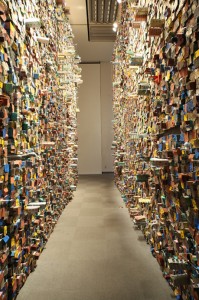
There's much more to be said about this show. The take of some of its contributors on consumerism, for example, with works like Krishnaraj Chonat's wall of waste computer products, manufactured in the developing world and dumped back there as soon as they're no longer fit for purpose, which reminded me of one of my favourite works, a wall of battered suitcases by the Italian artist, Fabio Mauri, or the more ambiguous and thought-provoking bazaar of stainless steel kitchen goods, an emporium of cooking utensils of the kind used in every Indian home and a gleaming, highly reflective reminder that what counts is not the pot but what it contains, which is often, as we all know, very little. But my favourite comment on recycling is the work shown here, two vertical panels made of recycled waste and reproducing in hallucinatory detail a part of Mumbai called Dharavi, the largest slum in Asia, and also constructed in its entirety of materials no one else has any use for. The work, entitled
Think Left, Think Right, Think Low, Think Tight, is an indictment of the living conditions within the slum, the verticality and narrowness creating a sense of oppression, as the catalogue rightly says. But it's also a massively ingenious and detailed monument to the human ingenuity of what it represents and for something that represents life at the lowest economic level imaginable, the kind of life most of us can't even contemplate, it's a work of extraordinary vitality and, even, optimism in the face of endurance, like those African toys, and coffins, so elaborately fashioned from discarded beer and petrol cans. As such, it goes dramatically beyond its creator's intentions, as good art should.

A final thought. Most of the work that impressed and provoked me was made by Indian artists, perhaps because they were telling me something I didn't know, or didn't know I knew, or didn't know I had the right to know. Perhaps if France's relationship with India had been more conflictual, or explicitly compromised by history, the work produced by its artists would have had more bite to it. As it was, the two artists who seemed to me to have dealt most successfully with the challenge the show offered were Stéphane Calais, who preferred to stay at home and use Indian ink to cover large sheets of paper with flowers and abstract designs on the principle that his 'Orientalism was as mutant as flu' and thus required isolation, and Leandro Erlich (interestingly, an Argentine artist who lives and works between his country of origin and Paris, and is thus neither French nor Indian), who has given us an installation of a typical Parisian bedroom (designed, incidentally, by Jacques Grange, who lives in the apartment that once belonged to Colette), through one window of which can be seen filmed images of a street in Bombay. They're fascinating to watch, as of course they would be; they're elsewhere and their otherness is reinforced by the frame of the window, which is both a limit and an aperture. As metaphors go, Erlich's installation, entitled, almost too neatly,
Le Regard, is as apposite as they come.




 Maybe it's because I was exhausted and suffering from a bad case of gallery back syndrome by the time I got to the Prado last week, but these two paintings, both by Velásquez, made a big impression on me as consummate images of weariness. Even the gods get tired. Mercury and Argos don't have the strength to raise their heads, while Mars, the epitome of the professional soldier who's seen too many battles, looks as if he's wondering what he'll be told to do next. Neither of these paintings, it seems to me, could have existed without the precedent of Caravaggio's extraordinary fusion of the mundane and the divine, although I suppose it's possible Velásquez may have seen no more than one or two examples of the Italian artist's work and simply been influenced by a naturalistic zeitgeist. (I've just checked and Velásquez visited Italy twice, in 1629-30 and 1649-51, so it's more than likely that he was perfectly familiar with Caravaggio and the influence he'd had by that time. It was during Velásquez's second visit that he painted the extraordinary portrait of Pope Innocent X, criticised by the pontiff for being 'too truthful'. I wonder what Mars would have said if he'd been asked.)


 n't alone. One of the first things he did as minister was hire a certain Mario Resca, initially as consultant and then as director general of the country's museums. Before taking on this important role, Resca was CEO of McDonald's Italia. So that'll be two McBacon Menus and a Michelangelo to go.


