Showing posts with label language. Show all posts

Saturday, 6 February 2010

The Wonder of Whiffling

A couple of years ago I wrote a post about a book called Toujours Tingo by, as I said then and will repeat now, the splendidly named Adam Jacot de Boinod. The book, a sequel to The Meaning of Tingo, trawls the world's languages for the wise, witty and inconsequential, gathering, among other gems, such terms as chapponage - the act of sliding a finger into a chicken's backside to see if it is laying an egg - and womba - the smile of a sleeping child.

Well, Mr Jacot de Bionod has done it again. His new book, entitled The Wonder of Whiffling is a mine, once more, of the kind of information you never imagined you needed and, once it's acquired, will wonder how you lived without.

To put you in the mood, here are three questions that only this book can answer:

A parnel is:
a) a species of seabird
b) a priest's mistress
c) the lining of a cassock

To call pigs to their food, a 19th century Irish farmer would say
a) hurrish
b) pleck-pleck
c) poa poa

An applesquire is
a) the son of a cider-maker
b) an orchard's bookkeeper
c) the male servant of a prostitute

If you'd like the know the answers to these, along with a host of other lexical wonders, I wholeheartedly recommend The Wonder of Whiffling.

Thursday, 14 January 2010

The art of public speaking...

...as exemplified by Sarah Palin on Fox News, when asked what she thinks about Obama's slump in the poll numbers:

"Of course they're sinking. It was just a matter of time before more of that reflection of the people's uncomfortableness that they feel towards this administration is manifesting in these poll numbers," she offered.

Wednesday, 23 September 2009

Mind your language

Productive dialogue is relatively easy among equals, perhaps because it's supported by a kind of openness that occurs when no one feels under threat and when the basic aim of the dialogue - greater understanding, a solution amenable to all - is shared. It can still be adversarial; productive dialogue isn't bland, but challenging. It challenges the listener to do at least half of the work, and often more; it recognises that speech that isn't attended to, and elaborated in silence, might as well not be spoken.

But when people feel that equality isn't there as a condition of dialogue, its nature changes. The lesser partners in the dialogue feels that insufficient attention is being given to them and their words. There's a sense of exclusion and people who feel excluded no longer trust the value of what they say. They start to shout, and interrupt, gesticulate. They become ill-mannered in order to attract the other's attention, while the other takes for granted that whatever he or she says will not be challenged, and begins to dictate. The dialogue is no longer collaborative, or even adversarial, but belligerent and oppressive. We see this happening all the time in the political arena. The people who feel powerless turn up the volume, and the volume of invective. They start to call their opponents Nazis, or faggots, or the Antichrist. The louder the noise gets the less those in power make the effort to listen. This is a paradigm of unequal dialogue.

OK, lecture over. Because what interests me is that, right now, the situation in Italy has reversed this paradigm. Berlusconi has an absolute majority in both houses of parliament, almost total control over national television, the most important means of communication, etc. yet he's behaving like a teabagger on the White House lawn. His language is consistently that of the underdog, rendered hysterical through deprivation. His opponents are, variously, communist, subversive, most recently farabutti (common crooks). This isn't the language of a man in power. This is the language of the dispossessed and the desperate.

He isn't the only one to indulge in this sort of degraded rhetoric. Renato Brunetta, minister for public administration (see picture), started his spell in office by accusing state employees of sleeping on the job, calling them fannulloni (layabouts). (I'll be looking at Mr Brunetta's lack-
lustre performance as consulente and university professor in a later post. For now, let's just say he has much to be modest about.) A few days ago, he decided to go one better than the boss and announced that the opposition in Italy was under the hegemony of an elite di merda (which needs no translation), an elite that deserved to morire ammazzato (to be murdered).

Perhaps the sort of bullying populism that SB and his government have ridden to power on makes such language necessary. In the meantime, the opposition, to whom nobody listens, measures every word.

Friday, 10 July 2009

The face of factual

I'm not a Strictly Come Dancing fan - I prefer reality shows that incarcerate the contestants and reduce them to a state of ratlike desperation - but my heart bled a little for Arlene Phillips today when I saw that she'd been sacked from the jury. No, I didn't love Hot Gossip - on the contrary. And I didn't much enjoy her tritely alliterative, overworked comments on the odd occasions I did see the programme. But surely even she didn't deserve the comments made by the woman who gave her the boot. BBC1 controller (brr...) Jay Hunt defended the decision by saying the show needed a 'different flavour', presumably newspeak for 'younger woman', and then went on to say, in some appallingly misplaced attempt at reparation: "Of course Arlene is disappointed. But critically she is incredibly excited about moving to The One Show. She knows at some point she is going to need to do something different with her career and this gives her the opportunity to become a face of factual on the channel and to be absolutely at the heart of what BBC1 does". "Critically"? "Incredibly excited" to be moved from the most popular Saturday evening show to a programme I surely can't be the only person never to have heard of - where, "critically", she will be expected to comment on the show she's just been dumped by? But even these horrors pale beside "the face of factual". Can anything be done to help this woman? No, not Arlene Phillips (66). Jay Hunt.

Sunday, 14 June 2009

Names

A footnote to my last post. Googling for images of house sparrows I found myself with an infinite selection of Johnny Depp's Jack Sparrow but surprisingly few pictures of the actual bird (in the first three pages, 3 birds to 51 Depps; it gets better later on). And it reminded me of a small boy I know who thought mice were named after the computer thingymabob.

Tuesday, 3 March 2009

Language

This was seen on a lamp post near Piazza Bellini in Naples yesterday. I don't think the last line is a joke. If it is, it's missing a heartfelt need. 

Monday, 10 November 2008

Recursion

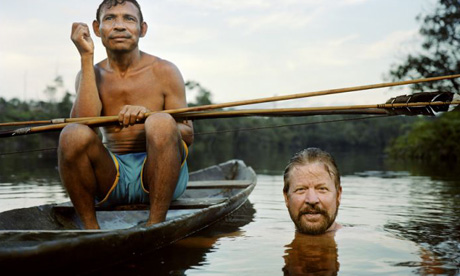
This great photograph accompanies an article in today's Guardian about the ex-missionary and linguist, Daniel Everett, and his experiences with an Amazonian tribe, as a result of which he's had probelms not only with God, and his family, but also with Chomsky. It's a fascinating article, whether you're interested in God or Chomsky - united, if nowhere else, by their notions of universality - and Everett's book looks well worth reading too.

You need to read the article to get the title.

Tuesday, 4 November 2008

Stick

There's an interesting piece on the Guardian books blog today about self-referential humour, triggered by a joke that turns out to be less lavatorial than one might expect. But it's actually the comments that made me copy the link and post this. One of the commenters - freepoland - asks what the name is for a map that's as big as the area it represents. 

This, spookily, quotes from a poem I wrote many years ago, which I'll post here if anyone shows a jot of interest. (As if.) But the best thing is the answer, supplied by regular commenter BillyMills: Language.

Saturday, 4 October 2008

God help us

“Say it ain’t so, Joe! There you go pointing backwards again ... Now, doggone it, let’s look ahead and tell Americans what we have to plan to do for them in the future. You mentioned education, and I’m glad you did. I know education you are passionate about with your wife being a teacher for 30 years, and God bless her. Her reward is in heaven, right?”

Sarah Palin debates.

Sunday, 27 July 2008

Rule of thump

A misprint I came across in a report I'm editing today, about banana cultivation in atoll islands. It's talking about how often banana plants should be fed with organic matter and suggests once a month as a rule of thump. Maybe I'm tired and bored (OK, I am tired and bored), but this has tickled me no end. It's like a homelier more approximate version of the law of the jungle. The rule of thump. Let's see if we can introduce into everyday speech. We could start with political discourse. As in: Gordon Brown KO'd by rule of thump.

Wednesday, 28 May 2008

(Sic) as a parrot

Watching daytime TV yesterday (yes, I've been staying with my mother), I noticed spelling mistakes in two consecutive ads. In the first , for a removal company (I think), 'geographical' was spelt 'georgraphical' (note the intrusive 'r'). In the second, claims were being made for a detergent that would clean all surfaces, including stainless steal (sic). I found my temperature rising.

Does this make me Lynne Truss? Or I am becoming sad in my own quiet way?

Sunday, 25 May 2008

A question of style

Yesterday’s Independent had two stories that reflected each other in the revelatory way skewed mirrors sometimes do. The first had to do with Naomi Campbell, who is still spitting fire about her treatment at the hands of British Airways. She denies that the company has banned her from its flights, and her luggage from Terminal Five. It has, however, ‘disrespected’ her. In the Devil Woman’s own, reported, words:

Someone from British Airways asked that I return to fly with them but this will not occur so early. I am speaking for all those that have been disrespected.

As a teacher of English (‘in my spare time’, according to the still mysterious ‘Luke Rocchi’), I wouldn’t know where to start with a text like this. Its sheer unnaturalness suggests machine translation from some arcane bureaucratic dialect. I may be quite wrong, of course; it may simply be the way people chat to one another in the world of high fashion. As in: Jean Paul asked that I share a line of coke in the back room but this will not occur so early. I particularly like the second sentence, which bears no logical connection to the first but smacks of Ms Campbell in what she probably imagines to be Nelson Mandela mode. Naomi, champion of ‘all those that have been disrespected’. It’s good to know she’s prepared to speak up for all the little people whose luggage also went astray but who didn’t have sufficient elegance or promptness of spirit to gob in a copper’s face.

A few pages later in the same issue there’s an article about the cosmetic surgeon, Martin Kelly, who died unexpectedly, and tragically, a few days ago. Kelly spent a fair amount of time reconstructing the septums (septa?) of people who share Ms Campbell’s world and habits, but he also, and principally, dedicated himself to people who don’t, including a small girl in Afghanistan, whose face was so deformed the local Taliban considered her a ‘devil child’ and wanted to have her stoned to death (with stones, not cell phones). Thanks to Kelly’s work, she is no longer a devil child. Now 11, she wrote to thank him:

First of all I say hallow to my doctor Moten Kalli. I’m Hadisa Husain from Afghanistan. I’m at school now and I’m very happy. I don’t have any problem and I’ll never forget you, and I’m waithing for my next opration. Thank you.

The spelling might not be perfect, but for efficacy of communication Campbell could learn a thing or two from it. No disrespect intended.

Monday, 5 May 2008

Error

There's an error in the previous post. Where I say 'adoring' I meant to say 'adorning'. I could have just corrected it but why waste a layer of meaning, albeit unintentional? As long as the ports have names for the sea...

Not to speak of the wonderful pain/paint slip-up from Lion Lion (Tom Raworth).

PS I've also just realised how ambiguous my final sentence is in the post below. I'll be thinking about this and getting back to you with some kind of clarification. Or not. Why waste a layer of meaning?

PPS I'm quoting myself. I'm very tired. I'll tell you why tomorrow. To prepare you for what's coming, I'll whisper the word 'train'. And that reminds me of perhaps the worst printing error I've ever come across. If you haven't read Anna Karenina, there's a spoiler coming up. (On the other hand, if you haven't read Anna Karenina, you deserve a spoiler.) At the end of the novel, in the edition I read some decades ago, Anna commits suicide by throwing herself under a 'good strain'. What a misplaced 's' can do.

PPPS And given that tiredness encourages this process of random association, I'm reminded of a comment made by Julian Bees from the ANSA English desk some years back, when told that human beings and chimpanzees share 90-whatever percent of their genes: 'Genetics isn't maths. It's spelling. You change a letter, you change the word.'

Wednesday, 9 April 2008

Punto e virgola

Each culture gets the windbag it deserves. Italy has Pietro Citati, a man who imagines that, by writing about Kafka, Goethe, Proust, et al, he's somehow earning his own place in the pantheon. What Citati doesn't seem to have realised is that the weight of the flea and the weight of the dog aren't just different, but on different scales.

He's now turned his vacuous critical eye on an issue which doesn't really concern him at all, except in a snobbish high-cultural way: the use of the semi-colon in English. I was in England when the poor thing's
imminent demise was announced in France, so I had the chance to read all the comments in the press. Apart from a woman who seemed to think that punctuation included just about everything, from grammar to register (I can't remember who she was, or where she wrote; perhaps you can), most people were fairly sensible about the business, whether they cared or not (I'm a semi-colon fan, as you may have noticed). The general mood was that the world, and language, and literature, will survive. Interestingly, very few people seemed to know exactly what grammatical role it played; the general feeling was that it marked a longer pause than a comma, a shorter one than a full stop. It was actually fascinating to see how many writers see punctuation less as semantic than as a sort of musical notation. A mark of breath.

Citati, though, cares. He really cares. He says that the murder (sic) of the semi-colon is worse, far worse, than the murders we read about each day in our daily papers: the murders of husbands and wives, daughters and sons, cousins and great-aunts, second cousins and step-brothers, nephews twice removed and great-great uncles on the mother's side (Citati loves accumulation; the longer the sentence, the easier it is to pop in a couple of semi-colons). People are nothing compared to that sexy combination of full stop, round, circular, plump, spherical (Citati loves synonyms) perched, hovering, poised, above the comma, caesura, curvaceous whatsit, er, punctuation mark. Who needs people? People aren't culture.

He then has a go at academic language in Britain today. He doesn't give any examples - why interrupt the flow? He simply complains that most sentences in Anglo-Saxon discourse these days are based on the three word structure of subject-verb-object. It would actually be quite hard to construct an argument on this basis, given that most English sentences also contain at least one article and an auxiliary verb, which would push the word count up to five or six. But what the hell. Citati isn't just an artist; he's a humanist. Even better, he's an Italian humanist. He doesn't need precision. It just has to feel good. It just has to make him look good.

He goes on to praise the Italian of today, by which he appears to mean his own, for
its dignitĂ , autoritĂ  and solennitĂ , as if these qualities were somehow more valuable than precision or, horror of horrors, invisibility, by which I mean a language that doesn't parade its finery or draw attention to itself. The problem with dignity, and authority, and solemnity is that they're the kind of qualities that popes and warlords and emperors base their power on, not writers. Writers shouldn't have, and shouldn't need, new clothes. Citati should check his wardrobe, before it's too late.

Monday, 28 January 2008

Spelling

I was writing about Berlusconi in a private email (yes, I'm obsessed) and my Google spell-check didn't recognise him. I clicked to see what alternatives I was offered and found, at the top of the list, wanderlust. So maybe it did recognise him after all. Maybe it's offering sympathy and advice rather than alternatives.

And talking of spelling, does any other language mark the connection between language and magic as closely as English? Spell. The shared root of grammar and glamour. Witch and which (OK, I'm being silly now.)

Thursday, 20 December 2007

Health

There's an interesting piece today by Peter Popham, the Independent's Rome correspondent, about his experiences with the Italian health system. Under an unnecessarily gloomy headline (Thinking of travelling to Italy for treatment? I would think again), the article kicks off by praising the country's emergency services for being fast, efficient, non-discriminatory and, above all, free. This echoes my experience. I've taken innumerable visiting friends with the most unlikely ailments and found humour, diligence, precision and drugs. On one memorable occasion, a stoutly devout New Yorker (by adoption) who'd tried to jump the queue by claiming to have a dodgy heart (rather than the less urgent sciatica) thanked the doctor who'd just pumped painkiller into her bottom with a macaronic Dio benedire tua famiglia (God to bless your family). Che Dio benedica la sua schiena invece (I'd rather God blessed your back), he replied.

He's less impressed by the care offered to less urgent cases. I think he's a little unfair here. After all, the Italian health system has just been judged, by WHO, the second best in the world (after France); the UK came 27th. Still, he could have a point. You may remember the problems I had with insurance after breaking my shoulder in Britain last year. Now where was I? Oh yes, I'd just arrived at the casualty department of an English hospital with an oddly dead arm. I was diagnosed within half an hour as the bearer of a humerus with a compound fracture and told to come back on Monday. Today was Friday. I have to fly back to Italy on Monday, I said. Oh well, they said, and gave me a scrap of cotton to use as a sling. You'd better go to hospital in Italy then. I was prescribed painkillers for the weekend. I queued at the hospital pharmacy, my dead arm in its scrap of cotton, and paid up for some codeine. I took them back to where my mother was waiting, distraught, in casualty and asked for a glass of water. I'm sorry, the woman said, we don't do water. You can get a bottle from the café.

Three days of excruciating almost sleepless pain later I was in Italy. Home. I went to my local hospital. They were shocked that so little had been done, with a sort of patriotic pride that the famous English national health had sent me away with nothing but a bottle of pills and a knotted handkerchief, but themselves did nothing; they didn't have an orthopaedic department. I was sent ten miles away to Terracina, which did. Unfortunately, by the time I got there, it was closed for lunch. I waited, sitting in the car, accustomed by now to the throb of my right arm as it wobbled in its paltry sling, wondering what would happen next. More x-rays, for which I had to beg (they should have been done at Fondi), and a prescription for an authentic two part, padded sling. Plus odd little injections into the stomach that Giuseppe had to do for me because I couldn't reach down to pucker the skin and jab at the same time.

In many ways, Popham's right. There was bureaucracy to deal with and the cost of 'tickets', as they're known here, with that fondness Italians have for concealing unpleasantries beneath the language of others. So why don't I agree with the article? Because I didn't feel dismissed, as I did in Wolverhampton. I didn't feel as though I had to pay for the water I needed to take my pills. It isn't the money as such, but the mean spiritedness of it that shocked me. There's something perverse about prescribing pills and denying the water that's needed to take them. Unless you buy a bottle of pure spring Malvern water, or whatever the label says it is you're drinking to ease the pain.

Saturday, 15 December 2007

Grim reaper

There's a jolly piece by Andy McSmith in today's Independent. Entitled Dancing on their graves and triggered by Tina Turner's unsurprisingly cool response to her ex-husband's demise, it casts an eye over some of the more memorably sour, if not downright cruel, reactions to other people's deaths. As someone who's never been at all afraid to say good riddance at the news of some despicable shit shuffling off his or her mortal coil, I thoroughly enjoyed the article and am looking forward to being able to celebrate the sound of, say, Margaret Thatcher or Eggs Benedict's bucket being resoundingly kicked.

On a style note, this short post contains four different ways of referring to mortality
(plus one in the title). You may have noticed and wondered why. The fact is that I've decided to avoid repetition, that bulwark of robust English prose, and adopt the Latinate use of synonyms as a gesture of goodwill towards my Italian readers. I do this without irony. Pietro Citati, kiss my ass. Ovvero Osculate my posterior.

On a purely informative note, the first pages to appear if you Google 'death' are two Wikipedia articles on, first, a death metal band called Death and, second, death metal music itself. These are followed by a fascinating site called the Death Clock, which tells you how long you're likely to live and provides a countdown, in seconds, to the actual moment of, er, death. (Yes, back to repetition.) It's a fun thing to do. By the way, optimism helps.

Monday, 19 November 2007

Magari

All English speakers of Italian will know how useful the little word magari can be. It expresses regret or longing, irritation or delight, according to tone and context. Whatever it means, it means it more effectively than any single English word. Students who ask for a translation watch me squirm as I come out with a five-, six-, seven-word expression that works just once. They're generally too polite to say it, but their faces say it for them. How on earth do you manage?

Magari
is one of a thousand words that don't have any simple linguistic equivalent in English. Italian, on the other hand, doesn't have a host of mundane, earthy terms such as, well, splodge. You can't skedaddle in Italian or faff around (I don't think) or squish. The range of Duh is only half-captured by the more historic Boh, immortalised by Moravia. In language, evolutionary niches always get filled but no one would seriously suggest that a giant terrestrial parrot has the elegance of a gazelle. Nor that a gazelle has the wonky charm of the now sadly extinct giant terrestrial parrot.

If you're amused by this kind of thing, as I am, you'll probably enjoy, as I would, a book called Toujours Tingo by the splendidly named Adam Jacot de Boinod. For more about the book, s
ee this review. Here's the first paragraph, to whet your appetite and, possibly, if you're French, to wet your finger (Yes, I'm thinking chapponage):

Tsonga speakers who have had a fruitless day's labour know it simply as walkatia. For Anglophones, it is the act of throwing down a tool in disgust. Someone fluent in Bakweri might soothe his walkatia by looking at a womba – the smile of a sleeping child. But all would probably shy at a Frenchman's offer of a spot of chapponage – the act of sliding a finger into a chicken's backside to see if it is laying an egg.


Monday, 2 July 2007

Chinese whispers

As someone who's made a (poor) living from academic translation in the past - I now make a poor living from editing my own dear language into UN-speak - I'm deeply impressed by good literary translators. I would never have read some of my favourite authors (Balzac, Bernhard, Perec, Saramago, Sebald, etc.) without them. I look at the Italian-to-English work of Tim Parks and William Weaver and a dozen others and marvel at how they manage to convey sense so effortlessly from one language to another. I do have some files of translations of poems by Pasolini and Sandro Penna tucked away, made in those heady youthful days when I felt it my duty to do such things, and I've translated a chunk of a wonderful novel by Renata Crea, a friend of mine, for the sheer pleasure of seeing it work in a second language (as it splendidly does), but I'd shy away from anything more, well, contractual. I think I'd get in the way.

Which is why it feels odd to discover that a short piece of mine, titled The Growing, is about to appear in a very smart-looking left-wing weekly in the Netherlands called Vrij Nederland (Free Netherlands). In Dutch. In the whole world of my acquaintance, I know two people who will be able to read it, so I may have to ask them to back-translate it for me in the hope that something amusing emerges. It usually does. Repeated back-translation can effectively send a text haywire, to the general hilarity of those involved. The story itself is creepy and part of a longer thing I've been working on for, effectively, years now. One day, who knows? it may appear in English too.

I remember being disappointed some years back when The Barcelona Review did a story called The Time it Takes because I was under the impression they translated everything they published into both Spanish and Catalan and I was dying to see what it read like in both. But my impression, alas, was wrong and the story remained as it was. And now it feels oddly incomplete.

Tuesday, 19 June 2007

Endangered species and how we can help

Tofa is a language spoken by nomads in the Eastern Sayan mountains of southern Siberia. To be precise, it's spoken by exactly 25 nomads, all of them old and unlikely to live much longer. When they die, Tofa dies with them. Languages are dying out at an unnerving rate, but what makes the loss of Tofa particularly poignant is that it possesses the suffix -sig, meaning 'to smell like.'

We can't do anything to keep the entire language alive, but I suggest we make a concerted effort to help such a charming and unique linguistic creature survive a little longer. It isn't hard. You walk into a room that smells of, say, socks, or your grossly obese ex-boss. You sniff, you pull a face, you turn to your companion and murmur: socks-sig or grossly obese ex-boss-sig.

You see? It's easy. And that way you'll have done your bit to keep this unparalleled linguistic item breathing for a few more years.

After which, the deluge. Hmm. Sewage-sig.