Showing posts with label paris. Show all posts

Saturday, 20 August 2011

Paris - Delhi - Bombay

We went to see the temporary exhibition at the Beaubourg yesterday. It's called Paris - Delhi - Bombay and contains the work of around 50 artists, divided more or less equally between France and India. It's a fascinating exhibition for many reasons, not the least being that it's small enough to deal with in half a day or less and not feel that the crux of it has been lost. India's relationship with France is very different to its relationship with Britain and it would be interesting to see what kind of tensions a similarly themed show might have if Paris were replaced by London (and, for the sake of correctness, Bombay by Mumbai). Here, the tensions of colonialism and its aftermath, which might have darkened, and enlivened, such a show or, for that matter, one that examined the cross-cultured visions of artists in France and, say, Indo-China, are attenuated to the point of invisibility. The mood of the show can sometimes be respectful to the point of discomfort, particularly so in the work of the French artists. The tone is established by a large piece at the entrance, a flag made of sequins that combines the flags of the two countries and is animated by a fan. It shimmers and twinkles and is altogether a thing of great decorative charm, the last thing one might expect from its creator, Orlan, but it's also an acknowledgement that the kind of equality such a melding represents can only be decorative, and a nod de haut en bas from a culture that doesn't do decoration in the same colourful, glittering way.

This sounds more critical than I intend, because I'm not quite sure exactly what line should have been taken, other than Orlan's, and the show, in one sense, is riddled with doubts about stance and appropriacy. The opening image to this post is of the exhibition's centrepiece, a massive female head by Ravinder Reddy. It's the kind of thing, on a smaller scale, that can be found in Indian villages. This size, it's both Koons-like and not. It's monumental kitsch to us, but that might be because we have no sense of what it might otherwise be if it were small. Kitsch runs through the show in one way or another, with its masters Pierre and Gilles occupying an attractively camp corner with their usual stuff, as though Bollywood were something they'd thought of first (and perhaps it was).

But there's western kitsch, which is necessarily deliberate at this level of high culture, and perceived kitsch, which may not be. Tejal Shah has a series of elaborately set-up photographs designed to express the dream lives of India's transgender community (and here the word may be appropriate), the hijra; one of them (on the left) is entitled You Too Can Touch the Moon; another has a glamorously undressed hijra lying on a sort of raft, being punted along by a young man naked except for a gilded loincloth complete with impressively large prosthetic penis. It's contrasted with the adjoining installation, also by Shah, which depicts a hijra lying bleeding on the ground after having been beaten up and raped by a urinating policeman. What we can't know, finally, is how much the first image itself establishes a sort of fond, but also cynical and knowing, distance between the dream fantasy and some more genuine and complex freedom, as yet unimaginable, in which prostitution and the violence it appears to provoke are no longer the only option. Another example of what must surely be unintentional kitsch, in my eyes at least, is a large piece by Riyas Komu, composed of eleven pairs of footballer's legs supporting a hollow tube bearing the words God is Great in Arabic. Hmm. It's one of those pieces that does what it says on the tin so blatantly that, once looked at, the work comes to an abrupt end. Which is sad, because the legs themselves are rather splendid.

Tejal Shah isn't the only person to worry about sex, and it's interesting to see how Indian artists take advantage of this dialogue with France to talk about who and how we fuck, and what the whole business entails. Like Shah, Kader Attia looks at the fate of transgender people in a bracing and often touching video of three transsexuals, in India, France and Algeria, while Sunil Gupta produces a kind of fotoromanzo, as they say in Italy, of an Indian gay man in Paris, who enjoys the freedom to display his relationship with an older man, while betraying him by night in one of Paris's most popular gay saunas, Sun City, itself a kitsch recreation of India and its iconography. There's a lot going on in this work, but also not very much, as though the freedom of the artist to deal with his issues were as unsatisfactory and superficial as the freedom his protagonist enjoys to both live life openly with an (extremely good-looking) lover and then shag all kinds in an ersatz dark room. But maybe, as we say, I'm projecting here.

Talking about heterosexuality and the social constraints imposed on women - a major theme of the show - one of my favourite works was that by Atul Dodiya, Devi and the Sink (shown here), which uses quotation and montage to talk about women's lives and the ways in which they are represented and conditioned. The neatly reproduced Leger in the top left-hand corner, where the slab of colour applied to the woman's face is both abstract and a sort of blindfold, is a particularly successful correlative to the central figure, whose ability to speak - or express anything other than bewilderment - has been suddenly removed by the no doubt affectionate attentions of her partner. Horns, it should be noticed, are also forbidden. A darker work by the same artist shows a store-front shutter bearing the image of the goddess Mahalakshami, bearer of prosperity, half rolled up to reveal an image of the suicide of three sisters whose parents were too poor to provide them with a dowry. It's not the most subtle work in the exhibition but that's no bad thing when one of the roles of a show like this is didactic, as the rather textbook-like introduction to the catalogue makes plain, and one of its strengths is the way it finds two contrasting, and antipathetic, pictorial languages to make its point: the brightly coloured icon of the god and the neutral, almost crude depiction of the suicide, like something from a Victorian penny-dreadful.

Two of the works that most impressed me were by women and they confirm my feeling that for sheer edginess and emotional discomfort women artists these days are streets ahead of their male counterparts. (Bourgeois and Messeger are obvious examples.) Anita Dube, who lives and works in New Delhi, takes human bones she has 'found' (as the catalogue chillingly states) and covers them in red velvet, sequins, lace and pearls, transforming them into objects that might be necklaces or household ornaments, musical instruments or fans, except that, of course, they aren't. The ability of art to transform and the limits of that ability are being interrogated here, to unnerving effect. Sheela Gowda is also drawn to red. She has made heart-shaped patties from cow-dung (holy shit...), covered them in vermilion, and strung them up to hang like those strings of embroidered elephants or birds you find in charity shops in the west. Another artist, a man this time, to use red is Sunil Gawde, in a piece called Virtually Untouchable - III (see left), composed of garlands of painted razor-blades. Red is the colour of blood, but it's also the colour worn by Hindu women on their wedding days and I wonder if the catalogue's gloss on this work, that its subject is the assassinations of three members of the Gandhi family, is what the work might actually be saying, or whether it might not have more in common with the other two pieces that use vermilion so effectively. One of the best things about a well-curated exhibition, as this certainly is, is the way disparate materials, in this case bones, cow-dung and razor blades, can be united in conversation.

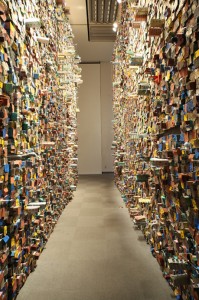
There's much more to be said about this show. The take of some of its contributors on consumerism, for example, with  works like Krishnaraj Chonat's wall of waste computer products, manufactured in the developing world and dumped back there as soon as they're no longer fit for purpose, which reminded me of one of my favourite works, a wall of battered suitcases by the Italian artist, Fabio Mauri, or the more ambiguous and thought-provoking bazaar of stainless steel kitchen goods, an emporium of cooking utensils of the kind used in every Indian home and a gleaming, highly reflective reminder that what counts is not the pot but what it contains, which is often, as we all know, very little. But my favourite comment on recycling is the work shown here, two vertical panels made of recycled waste and reproducing in hallucinatory detail a part of Mumbai called Dharavi, the largest slum in Asia, and also constructed in its entirety of materials no one else has any use for. The work, entitled Think Left, Think Right, Think Low, Think Tight, is an indictment of the living conditions within the slum, the verticality and narrowness creating a sense of oppression, as the catalogue rightly says. But it's also a massively ingenious and detailed monument to the human ingenuity of what it represents and for something that represents life at the lowest economic level imaginable, the kind of life most of us can't even contemplate, it's a work of extraordinary vitality and, even, optimism in the face of endurance, like those African toys, and coffins, so elaborately fashioned from discarded beer and petrol cans. As such, it goes dramatically beyond its creator's intentions, as good art should.

A final thought. Most of the work that impressed and provoked me was made by Indian artists, perhaps because they were telling me something I didn't know, or didn't know I knew, or didn't know I had the right to know. Perhaps if France's relationship with India had been more conflictual, or explicitly compromised by history, the work produced by its artists would have had more bite to it. As it was, the two artists who seemed to me to have dealt most successfully with the challenge the show offered were Stéphane Calais, who preferred to stay at home and use Indian ink to cover large sheets of paper with flowers and abstract designs on the principle that his 'Orientalism was as mutant as flu' and thus required isolation, and Leandro Erlich (interestingly, an Argentine artist who lives and works between his country of origin and Paris, and is thus neither French nor Indian), who has given us an installation of a typical Parisian bedroom (designed, incidentally, by Jacques Grange, who lives in the apartment that once belonged to Colette), through one window of which can be seen filmed images of a street in Bombay. They're fascinating to watch, as of course they would be; they're elsewhere and their otherness is reinforced by the frame of the window, which is both a limit and an aperture. As metaphors go, Erlich's installation, entitled, almost too neatly, Le Regard, is as apposite as they come.

Thursday, 15 November 2007

Squabbling over kippers

Finally, a story that combines great literature, down-and-dirty sex with minors, gratuitous violence and, er, cultural heritage issues. The house in London in which Paul Verlaine and Arthur Rimbaud loved, wrote and fought over smoked fish has been saved from property developers thanks to the pioneering work of the charity Poets in the City. They plan to turn the house into a rendezvous for the poets' admirers and creative offspring.
"It is probably going to be more tea and cake than absinthe," said Graham Henderson chief executive of Poets in the City. "A lot of people have been working hard over a long period of time to get the house saved.

"It is all on the drawing board at the minute, but we envisage a place that is a celebration of Verlaine and Rimbaud, where poets and enthusiasts can meet, do research and hold events."

The house is in Royal College Street, so if you're feeling vaguely maudit, you know where to go.

PS. By pure chance I spent two weeks last year in one of the buildings Verlaine lived in during his years in Paris, in rue Nollet, just round the corner from Place du Clichy. I don't have a photograph to prove this (and I'm sure you believe me in any case). But I do have one I took during my stay which captures something of the rather dark and perverse nature of the two poets' relationship.

Here it is.

Monday, 17 September 2007

This is not a time for dreaming...

...is the name of a video we saw this summer at the Beaubourg. It's on the lower of the two floors, halfway down on the left and was made by Pierre Huyghe, an artist I've never come across before. I always find videos in galleries difficult because of the way they impose their time scale on you; they won't let you dawdle or speed past them after a cursory glance They have the advantage and disadvantage of narrative, or narrative potential. But this one captured and held me. It re-enacts Le Corbusier's experiences at Harvard (which must have been dreadful if this work is anything to go by) and uses string puppets. There are so many ways in which the work delights: the technical skill of the puppeteer, the emblematic yet personalised nature of the puppets, the teasing way in which it satisfies and fails to satisfy our search for narrative as it veers from one kind of representation to another, from (puppet) naturalism to symbol and archetype. If I remember correctly, Harvard is represented as an enormous malevolent black bird stalking across the stage. At one point the puppets manipulate their own puppets. There are moments of great lyricism as what seems to be an ecological undercurrent finds expression in the growth of a tree. I don't have any photographs of it to show you (obviously), so you'll have to go and see it yourself. You won't regret it.

Friday, 14 September 2007

A rose is a rose


Giuseppe made friends with an Italo-French florist fifty yards down the road from the flat we were in, in Boulevard Saint Germain, and managed to scrounge three separate bunches of roses during our two-week stay. They were just the way he likes them, blowsy and open, with the petals about to fall. He calls them wild, although there is probably nothing growing that's less wild than this kind of highly cultivated rose, with the obvious exception of much of the food we're daily expected to eat.

Hausmann rules, but not always

One of the joys of Paris - of central Paris, at least - is the endless variation on the theme of Hausmann; street after street, quartier after quartier, of houses that follow the same essential rules of architecture, yet each with its je ne sais quoi, a colour, a detail, a proportion of window, almost identical yet not quite; harmony without regimentation, simply because it's better that way. It makes sense.

And then you turn a corner and see two little buildings like this, squeezed into a wedge of space that's good for nothing else, idiosyncratic, unplanned, but still with the single line of guttering to unite them, and the garret window, and the green of the smaller façade tuned into the probably mildewed roof tiles of its slightly more prosperous neighbour, although both of them have almost certainly seen better days.

Wednesday, 12 September 2007

Writing as madness

This summer, I saw a painting I'd never seen before, in the Centre Pompidou. Entitled Peinture (Ecriture rose) and covering a fair-sized chunk of wall (maybe three metres by four), it's the work of Simon Hantai and was done in 1958-59, which makes it almost half a century old. It's remarkable for a number of reasons, none of which can be deduced from the very poor photograph of part of it that you can see above, perhaps the most obvious being the fact that the colour pink, despite the work's title, isn't used at any point (as Helene Cixous has pointed out). The symbols on the canvas are references to earlier works but the body of the painting, its essential surface, is composed of writing. Hantai spent a year on the picture, working each morning to cover the entire canvas with meticulously copied extracts from philosophical and religious texts. The effect, of course, is to annihilate their meaning, but it's also a monument to the word as object in the same way that anything produced by a pre-Gutenberg copyist might be considered to be.

Two or three days later we were in the Arab Institute near Notre Dame, an extraordinary building containing a small but fine collection. Among the exhibits was an eighteenth century Iranian copy of the Koran, inscribed on a roll with the same kind of maniacal devotion as Hantai's, and, whatever its intentions may have been - and they were surely diametrically opposed to those of Hantai - the final effect is remarkably similar. In both cases, the actual sense of the word is subsumed in the representation of it as sign. The purpose of this Koran must have been to make the holy word available to its readers, but the manner of its transmittal renders it useless other than as totem. It disappears into the paradoxical beauty of the work as completely as Hantai's religious and philosophical texts, written in what appears to be a variety of coloured inks - red, blue, green, but never pink.

Penis, Paris

The image is rather ghostly, but you should be able to make out the form of a rather substantial male member on this toilet-paper roll. It's isn't remarkable in itself. The penis, after all, is to graffiti in public toilets as Paris Hilton is to gossip magazines. But it was rather odd to find it in the Ladies at Montparnasse cemetery. Don't ask.

Friday, 7 September 2007

Bars

This bar is just over the road from La Maffiosa, on the corner of rue des Dames and rue Nollet, where we stayed last year. Its slightly down-at-heel exterior makes it look as though it's been like this for years, but it was actually being put together by a group of people last summer. We walked past every day and watched them working on it in a touchingly amateurish fashion, wielding tools with a sort of wonder at their ability to perform the allotted task, hammering and sawing and painting in passionate, neurotic flurries before opening a bottle and sitting around one of the tables to laugh and look anxious and drink, covering scraps of paper with figures and sketchy plans of the place. Never has a drinking hole been christened with such regularity, from conception to birth.

We missed the opening night because it took place on the day we left. It seemed impossible they'd be ready - the tables and chairs were stacked at the back, the lighting was hanging from the walls, the paint on the shelves behind the bar still looked wet. But we're assured they were, and the evening was a great success. Now it's settled into the landscape, attracting its natural constituency, identical to the people who created it.

It's fifty yards from another bar which caters to northern African transvestites, off-duty before heading back to Pigalle, I imagine, or Avenue du Clichy. We had a drink there one rainy afternoon last summer, somewhat against my better judgement. The middle-aged woman behind the bar, generously bosomed and squeezed into a tight black woollen dress, seemed thrilled to see us, perhaps assuming we were there to raise the tone of the place. She scurried across to our table with a dishcloth and a plate of nuts we hadn't asked for. She was about to put the plate down when I
reached for my umbrella and knocked the nuts all over the just-wiped table. With a nonchalance I still admire, she gathered them up in her hand and put them back on the plate. Merci, madame.

I didn't have to eat them, I know. I could have left them on the plate, as Giuseppe did. It was my fault and no one else's that I spent the next two days poised between bed and bathroom, my only significant activity projectile vomiting.

La Maffiosa (sic)

Back to Paris, where we saw this sign outside a pizzeria in rue des Dames. It's extraordinary the extent to which criminality can acquire a veneer of folksy charm. Who knows how long it will be before we see a cartoon image of Mr Weeny the pederast (with dog) outside an amusement arcade (if that's what they're called now)?

Let's hope they spell it right.

Thursday, 23 August 2007

Garden furniture


The Musee Delacroix was poky, dangerously overheated and chock-full of second-rate stuff by M. D himself and others. Even the atelier, which you feel ought to be revealing, was dull. The garden though, in its small way, was very pleasant. I'm a sucker for formal gardens and it was fun to see the degree of formality achieved here, in what's really no more than a tiny courtyard squeezed in between buildings. I swear I didn't move the chairs.

And there were some nice postcards of sketches from Delacroix's Moroccan travels in the little shop.

Bon jour monsieur

It wasn't until I'd taken the photograph of this intriguingly simple portico just round the corner from Notre Dame that I noticed someone getting dressed beneath it. Another reminder of the enormous number of people sleeping rough in Paris. But also proof that what we do when we take a photograph is stop using our eyes.

It's what we don't see as we snap away that can often give the image resonance.
Posted by Picasa

Tables for two

French bar and restaurant tables are notoriously petits, particularly for someone used to the more generous proportions of those in Italy. Roughly speaking, a table for four in Rome would be expected to seat eight, or even twelve, in Paris. But these chipped but chic little tables, spotted near St German des Pres, surely take the biscuit (an object they curiously resemble, in size at least). We calculated that they would just hold two cafes cremes and one of those dinky plastic things with clips that contain the bill.

Two wedding dresses and a mattress

Seen in the Marais.

Tuesday, 21 August 2007

Dogs

One of the hardest things about travelling is that you often have to leave your pets behind. This is particularly the case if the journey touches Britain, whose irrationally draconian anti-rabies measures make it impossible to take your dog: because, I admit it, I'm thinking dog here. Even more, I'm thinking Toffee.

We left Toffee in her own house (which we share), with Daniela and then Renata, people she knows and loves, so she was fine. We were the ones who suffered. Suffering takes many forms. Giuseppe phoned home every day for detailed bulletins on her health and general well being. Toffee licks the mouthpiece if she hears her name, which is unhygienic but endearing (to us), and this ritual was duly performed each afternoon.

I'm more grown up about it (I also think the phone thing might upset her at some deep level, the way time travel or full face transplants might upset me). I take photographs of other people’s dogs. Paris is a very good city indeed for this; it's hard to cross a street without seeing half a dozen small perfectly coiffured tykes being taken out by their owners. Jack Russell terriers are definitely this season's flavour; the animaleries along the Seine around Pont Neuf are full of them, with their prices pitilessly falling as they move out of puppyhood; although bulledogues (the French kind, hence the spelling) are hanging in by their oddly arranged teeth and look set to weather the canine fashion storm.

Then there are the much larger mixed-breed dogs that lope around with, and protect, the thousands of clochards in the city. The psychology's pretty basic. People like me, who go soft at the sight of most animals, tend to give more, telling ourselves that our money will be spent on biscuits. One guy who turned out to be from Manchester, strategically placed on his rucksack outside a place that sold the most delicious bread, told me he'd just bought something to stop his bitch - Sensy (because she’s sensitive) - going on heat. This information made me even more generous than I'd intended. He said that he could sleep more easily, knowing that Sensy was there beside him. We must have had similar circuits because I noticed Sensy and her life-partner half a dozen times, walking, sleeping outside the Monoprix on rue de Reynes. A man came out of the store and gave the Mancunian a bag with bread, cheese, tabouleh, screw-topped wine, two bottles of water and a sizeable bag of dog food. I wonder how often this happens, if it’s a frequent gesture or if I was lucky enough to see something exceptional. I hope the former.

Then, one afternoon, a big golden Labrador flopped across to us and put his front paws round my waist and his cold wet nose against my stomach. Begging for love, I thought, so I was half right. His owner, who rolled up seconds later with his hand out and a friendly smile, must have trained him to trawl for cash. But hey! everyone's happy. (Except for people who 'don't like dogs'.)

They don't even have to be real. I took these two photographs of toy dogs in the window of a shop that was closed for August. I had one not that different when I was small, with small wheels on each paw and a handle at the back like a trolley case; I don't know what happened to it.


Batignolles or I'm back from Paris

Back after three weeks away, I'll start with something typical... The boulangerie was one of the many Paul scattered over Paris, this one in the middle of the rue de Levis street market. The man isn't known to me, but his hair and general stature reminded me of Georges Perec, whose space in the crematorium of Pere Lachaise I didn't see this year. So this is a little homage to the memory of Perec, in the city he honoured.