Monday, 16 March 2009
Strano is as Strano does
The name of the caterwauling, gesticulating oaf with the slice of mortadella hanging from his lips is Nino Strano, the place - alas! - is the Italian senate. Nino Strano is insulting Romano Prodi and his supporters in the way that comes most naturally to a man of culture, by calling them 'faggots' and 'pieces of shit'. Strano says he has gay friends – I hope that's no longer the case. He lost his seat at the last election but has been chosen as a candidate, by Berlusconi, for the European elections later this year. Remember, in Italy, we don't get to choose who we vote for; that's the job of the party, which just knows better. We give carte blanche to each political party to make its own decisions about who should represent us. In his efforts to clean up his act defend his honour, Strano is threatening people who show this film, including YouTube and individual bloggers, with legal action. Which is why I'm posting it here. And which is why I'm asking anyone who reads this and also has a blog to post the same film. It's a small thing. But so is Nino Strano.


Sunday, 15 March 2009
Review
 I'd just like to point you towards an excellent review for Little Monsters from The Fiction Desk. This may be the first time that my moustache has been called out in a review, and it's certainly the first time the novel has been rated more highly than a plate of cacio e pepe, one of my absolute favourite dishes and possibly the last remaining reason for living in Rome. (I'm joking. Just.) I can't tell you how much this means to me.
 Wednesday, 11 March 2009
Saturday, 7 March 2009
Press freedom in a democracy. Lesson one.
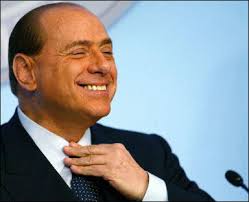 Dario Franceschini, the new PD leader, though probably not for long, suggested a couple of days ago that the unemployed should receive some kind of indemnity payment from the government. I thought they already did, or at least had the right to do, but apparently I was wrong. There were vaguely positive murmurings from left and right, possibly because it looked like the kind of thing Obama might propose, so it's a bit of a vote-catcher and it never hurts to be associated with one of those.
 But Berlusconi immediately ruled the proposal out. Not because it was unfair, or because the funds weren't available. His argument, in pure Silvio fashion, was that it would encourage employers to sack people. These people would then pick up their dole cheques and be re-hired illegally at lower wages. What kind of brain does it take to come up with that kind of scenario? (Yes, this question is intended to be rhetorical.)
He also said that Italy is the only democracy in which state television criticises the government in power with impunity. (If only this were true.) He's obviously been taking lessons in democracy from Putin. Oh yes, his latest word on the economic crisis. He admits there is one, but insists that the media exaggerate it. Which media? Not, one assumes, the huge swathe of it owned or controlled by the grinning buffoon himself.
Thursday, 5 March 2009
Ave fellow thugs

The back in the middle of this picture belongs to someone called Don Giulio Tam. He defines himself as an 'itinerant Jesuit' but he's actually one of the gang of break-away catholic traditionalists, headed by Lefebvre and recently re-admitted to the fold by Ratzinger. He looks as though he's calling for order or maybe directing traffic in this picture, but what he's actually doing is making a Roman salute, the kind Mussolini made fashionable all those years ago, to a group of right-wing extremists (sorry, Forza Nuova) in Bergamo. What with Archbishop Robinson et al, it looks as though, for the Vatican, blackshirts are the new black.

These must be prayer sticks.

Wednesday, 4 March 2009
Sheep
 These two sheep, plump and sloping out of the wind as they head over the brow of the hill, are a wonderful shorthand for a bucolic life the people who commissioned this painting - closed order nuns - had probably never experienced. They adorn the back of a bench in the majolica-tiled cloister of Santa Chiara in Naples, the one with the martyrdom of Saint Catherine, in comic strip detail and sequence, on a neighbouring wall. Other images show carousing groups, dancing, and various other high jinks, which must have rubbed salt into monastic wounds. Or maybe not. The convent was, after all, in Naples.
A wheel within a wheel
 This is a convent wheel, currently in the Santa Chiara museum in Naples. I'd never seen one before. It was used in the convents of closed orders, whenever communication with the rest of the world was required. The nun would stand on one side of the wheel and speak into the drum. The sound would travel into the other half of the drum and out of the opening on the other side. I was there with my sister, we tried it and it works extremely well, though it wasn't clear to me why it should be a wheel rather than, say, a wall, unless the idea was that it could be spun round to accommodate particularly tall or short petitioners. Although presumably the nuns were accustomed to kneeling... The wall of the cloister closest to the museum contains scenes from the martyrdom of St Catherine. I wonder if the wheel ever reminded the cloistered nuns of the rather gruesome images outside.
Tuesday, 3 March 2009
Balancing on the Edge of the World
 I first came across Elizabeth Baines through Fictionbitch, which struck me immediately as one of the liveliest and most thoughtful literary blogs around. Intrigued, I bought her collection, Balancing on the Edge of the World, and was moved and impressed by its intelligence, emotional acuity and sheer variety. Since then, we’ve met twice, far too briefly, and it was a great pleasure on both occasions, although the second time Elizabeth’s journey home, if I remember correctly, was interrupted by a random sniper outside Manchester. I hope this has no significance. Last year I was lucky enough to be interviewed by Elizabeth on my own Cyclone tour, and I’m delighted to be able to return the gesture of respect and curiosity that this sort of interview represents. I’m only sorry we weren’t able to sit down together and have a glass of wine while we were about it. Although after the sniper incident perhaps this is just as well.
For those of you who don’t already know Elizabeth, this is what she has to say about herself:

Elizabeth Baines is a writer of prose fiction and prize-winning plays for radio and stage. Her short story collection, Balancing on the Edge of the World, was published by Salt in 2007 and was long-listed for the Frank O'Connor International Award for the Short Story 2008. Her novel, Too Many Magpies, will come from Salt in late 2009. Elizabeth was born in South Wales and now lives in Manchester. She has been a teacher and is also an occasional actor. She writes the critical-commentary blog Fictionbitch and also has her own author blog.
I asked Elizabeth three questions about her work. Here they are, with her wonderfully illuminating answers.
Many of the stories in Balancing on the Edge of the World deal with, and illuminate, social issues: homelessness, street violence, divorce, infidelity. There’s a strong sense not just of place but of their being rooted in social and economic circumstance that’s refreshing in a form which sometimes tends towards the airy-fairily universal, while the conflicts the stories enact are powerfully realized at the personal level, but are also, in a large sense, political - issues of power and so on. At the same time, a story like ‘Conundrum’ shows a healthy distrust of political orthodoxies. This obviously isn’t simply the effect of writing about the world ‘as it is’, but the result of decisions about what constitutes reality and how we, as individuals, shape and are shaped by it. To what extent are you aware of thinking ‘politically’ – if this makes sense – as you write? And have you ever found a story leading you into a place you’re at odds with on an ideological level? If you have, what did you do?
Well, I said right at the start of this tour on Barbara Smith’s blog that I’m just writing about the world as I see it, but the fact is that I think I do see the world politically, though in the widest sense, as you say. Since I’ve revealed so much on this tour already, I don’t mind saying that I grew up with a raging sense of injustice. As a teenager I had a very stormy relationship with my parents (so I felt big injustice on my own behalf!) yet I was also naturally deeply affected by the class, race and religious prejudice they had experienced and which informed their attitudes, and also by the non-conformist bent of my Welsh family on my mother’s side. So yes, from early on I was made political in the sense of questioning things and also protesting against authority and whatever seems unfair. But since what both my Irish father and Welsh mother had always struggled against was religious and political orthodoxies, I was always going to be, as you note, suspicious of orthodoxies of any kind – well, not just suspicious, I’d say, but passionately concerned to expose their potential iniquities. Two other more explicit examples of this in Balancing are ‘The Shooting Script’, a satirical story about an arts worker from hell, which shows how the politics o f equal opportunity can be paradoxically twisted to wield unfair power, and ‘The Way to Behave’, another ironic story in which a wife uses the unthinking pieties of a certain strand of feminism to take revenge on another woman, her husband’s female lover. Take that issue of feminism: it would be hard, I think, not to be convinced by the humanitarian insights of true feminism, and indeed my first two novels were fiercely motored by them. But by the time I came to write my first radio play I had seen how certain strands of feminism had become problematic, even damaging orthodoxies, and this was what Rhyme or Reason, that first play, was about. (Orwell’s Animal Farm is my yardstick, after all!) Some feminists were very unhappy about that play, especially when it was nominated for Sony Awards and Harriet Walter won Best Actress, as they felt I was very publicly discrediting feminism, but as I say I write the world as I see it, or as far as I can see it, and indeed it’s precisely that kind of blanket thinking (you’re with us or you’re against us; all x are good, all y are bad etc etc) that I have often explored in my writing.
As you note, however, what I’m concerned with is the way all of this operates on the personal, experiential and psychological level, which is why I’m so concerned to portray the sensual aspects of experience (including a concrete sense of place etc). This is the real politics for me: the way those social and economic circumstances affect us on the deep emotional level and consequently affect our sense of ourselves in the world. For this reason – as you also indicate – I’m deeply concerned in my writing with the question of reality, and the contingency of reality, and the psychological matter of viewpoint: What constitutes reality? How does our sense of reality differ according to our circumstances, our place in the balance of power?
As for the question of whether a story has ever led me to a place with which I’m at ideological odds… Well, I think it must be clear now that if by ideology we mean a pre-packaged system of thought then I’d prefer to be free of authorial ideology, although I know I have slipped up once or twice: nowadays I’d be far less hard on the men in my first novel The Birth Machine than I was. I’d say that writing well is a process of looking for the truth, rather than imposing a set of preconceived notions. It’s true that as I’ve indicated there are certain overriding and indeed passionately-held attitudes I always bring to my writing, chiefly my concern with all forms of unfairness, cruelty or domination – social and personal, intended or unintended. But what I want to do above all in my writing, nowadays at any rate, is understand the psychological basis of these and other human impulses, and so for this reason nothing is out of bounds in terms of subject matter, nor the viewpoint of any protagonist – I’d get inside the mind of Hitler were I capable of it. In ‘The Way to Behave’, for instance, the behaviour of the wife is pretty underhand and, according to my own personal principles, inexcusable on moral terms, but entirely understandable. By getting inside her head and her pain and at the same time showing the devastation for the woman on whom she takes revenge, I hope I’ve come to some kind of deeper understanding of the tragedy of the whole situation. It’s in the treatment rather than the subject matter, I think, where the politics of a piece of writing lie, and I never write without a strong political consciousness (in the widest sense!), so no, I have to say I haven’t ever found a story leading me away from my politics at the time of writing. (Needless to say, as I’ve also indicated, my politics/insights have changed and developed as I’ve gone on living and writing.)
You also write for radio. I don’t know if you’d agree with this but, for me, writing short stories is a solitary business but also one that gives the writer enormous freedom, given that the activity, for most of us, has practically no economic return (alas!) and doesn’t require– or even presuppose - a particular reader or group of readers. I imagine that writing radio drama is a much more collegial affair, both explicitly - working with producers, actors, etc. – but also implicitly, in terms of internalizing the needs of the medium. How far are you aware of writing for a specific audience when you write for the radio and do you see this as a hampering constriction or a challenge?
Well, there’s an obvious difference in the sense of audience for the two forms, but I have to say that my sense of an audience has changed for both short stories and radio. I wouldn’t say that I felt exactly as if I was writing for myself or in isolation when I first started writing short stories, since I was writing into a literary magazine culture which inevitably influenced me, and which gave me a sense of a literary community and constituency – but yes, that also gave me great freedom because of course literary magazines are the places for innovation and individuality. Funnily enough, when I wrote my first radio play, Rhyme or Reason, I did so with even greater freedom, and with even less sense of having to please an audience, as, frankly, I simply wrote what I wanted to hear and didn’t do what you’re always advised to do (nowadays at any rate) and listen to lots of radio plays to see how it’s done and what’s wanted. And that’s how it was for my first few radio plays. Indeed, I was told by one producer that anything I wanted to write she would produce, and although I had an exhilarating sense of the huge audience out there for radio (compared with that for short stories, at any rate!) I had no sense of needing to please it beyond doing what came naturally to me. But as everyone knows, in the end BBC Radio finally caught up with the other media and became market-conscious, and the sense of audience became everything – and pleasing it the holy grail. And the audience that the commissioning editors had in mind was not the one I had previously envisaged: above all, it wanted ‘heart-warming’ stuff, apparently, and the last thing it wanted was irony or satire – my main stock in trade, especially when it comes to drama. As I mentioned on Scott Pack’s blog, I took this as a challenge (well, there wasn’t much else I could do other than give up!) and it was an interesting battle, with losses and gains. I don’t think I ever internalized the strictures (personally, I didn’t agree with the BBC assessment of their radio audience!), but consciously looked for ways of pushing at the boundaries, and I slipped in a few satirical plays that way. But of course, as you say, a great deal depends on others in drama, and one play I wrote as satire wasn’t produced as such. On the whole, therefore, I’d say I felt hampered rather than extended by the restrictions, and when my producer gave up radio I stopped doing radio too for the present. (It’s possible that things have become different again in radio since.)
However, I’d say that the whole experience of writing for a well-defined audience, and for actors and directors who challenge the lines they have to speak and the motivation of characters, affected my sense of the audience for prose: I think it sharpened my sense of the need for clarity and accessibility. This was reinforced by the fact that (as I explained on Scott’s blog) magazines prepared to publish experimental work disappeared for a time, making me feel the need to write for a more conventional short story market. But I think my experience as a dramatist has made me strive harder for accessibility even – and perhaps especially – when I’m trying to do something unusual in a story. Whether my prose has actually changed as a result is probably for others to decide.
Other interviewers have spoken about your voice, and I’d agree that there’s a strong sense that these stories are coming from the same place, a lot of which I think is to do with your language choices, which strike me as both spare and surprising, and the acuteness of your observation. But it’s also true that the stories demonstrate an enormous range of moods, and styles. I’m not talking so much about the experimental/traditional opposition, which you’ve already discussed, as I am about the nitty-gritty of tense, punctuation, viewpoint. Is this range, which I admire very much by the way, a result of letting the story dictate its form or of your desire, as a writer, to avoid the equivalent of type-casting? And do you think it strengthens or weakens the collection as a whole? (I should say here that I think the collection is greatly strengthened by it!)
Well, thank you, Charles! I shall return the compliment, as I in turn find your collection impressive and engrossing for its breadth of style and mode. For me, as I know it is for you, it most definitely is to do with the requirements of each individual story. Take the two stories I talk about above, ‘The Shooting Script’ and ‘The Way to Behave’. As stories examining overtly social issues and featuring wicked plotting on the part of their characters, they lent themselves naturally to a conventional satirical format where, along with a satirical voice, plot is uppermost. There is however a difference in the way their narrative voices operate (and thus in style), and this is a result of the different focus in each of the two stories. In ‘The Shooting Script’, the plot that the devious arts worker weaves is pretty complicated (comically complicated, I hope!), and complicated enough to be the focus of the story. The story was therefore best served by a first-person narrator with whom the reader could identify, as she tries to work out what he’s up to and forestall him. And because the story has a basically social focus (the corruption to which arts organizations are vulnerable), the appropriate voice was a detached, ironic one, and since this is best achieved via hindsight, the story is inevitably cast in the past tense. ‘The Way to Behave’ has a more complex narrative voice, which it can afford because the plot hatched by the woman in this story is simpler, and which indeed is inevitable because the subject matter is more personal, concerned with relationships and emotions, and because (following on from that) the focus is the psychology of the plotting character. Therefore the narrative voice is that of the plotter – first-person narration and present tense giving immediacy (I hope) to the portrayal of her psychology – but the irony here resides outside that voice: the reader is intended ultimately to take her in an ironic light. Right at the other end of the spectrum is a story like ‘Going Back’ which is about a new mother breaking down emotionally, and the potential consequent breakdown of the family. The only way to render this truthfully was to get right inside her psychology, and the way to do that was to make the prose follow her obsessive and broken thought patterns with repetitions and lines broken on the page, and a complete lack of speech marks, illustrating that what is being represented is not an objective ‘record’ of what other characters say, but the way the protagonist hears it, part and parcel of what’s going on in her head. However, much as this story works to replicate the mother’s psychology, it is told in the third person rather than the first, as a way of setting her psychological trauma in the unnerving, vast and impassive context of geological and biological history, and setting the seal on her alienation. Although it’s a very different kind of story, I use some similar techniques in ‘Daniel Smith Disappears off the Face of the Earth’. I don’t employ conventional speech marks here either, since as the victim of a mugging Daniel can’t experience what is said between him and his muggers in any objective way, but at the same time it is also frighteningly alien to him, so I render it in italics.
I must add, as usual, that I don’t think these things out in this intellectual way while I’m writing, but do it all more instinctually, and the format/style will come to me right at the start, integral to the story.
Language
 This was seen on a lamp post near Piazza Bellini in Naples yesterday. I don't think the last line is a joke. If it is, it's missing a heartfelt need.
Saturday, 28 February 2009
Italy, il bel paese
 Just in case you can't see. the first knob provides condoms, the second a throw-away lighter and the third those generously large cigarette papers for people who like a long, cool smoke. The dispensing machine is outside my local newsagents and must have smoothed out many an otherwise bumpy evening.
Tuesday, 24 February 2009
Homesick for everywhere but here
 Norman Geras asked me to write about a book that has influenced me in some way for his Writer's Choice series on normblog, according to the Sunday Times one of Britain's finest 100 blogs. I chose Christopher Isherwood's second novel, The Memorial, written immediately before the Berlin novels that made his name. Isherwood's pretty much out of fashion these days and I've had some harsh things to say about some of his later diaries myself, but I love this novel, and I wish it were more widely known. You can read why here.
Friday, 20 February 2009
Numbers
When reporters asked Berlusconi yesterday whether he'd seen Roberto Benigni rip him to shreds at the Sanremo Song Festival last Tuesday, before an audience of 15 million, our Leader Minimus said, with his habitual smugness, that he was one of the 45 million Italians who hadn't watched the Oscar winner's performance. This may be the only occasion in which Berlusconi has admitted that not watching the usually ever so 'umble state television is a valid, even preferable, option. It would be comforting if he spared the odd thought for the 47 million Italians who didn't vote for Berlusconi in the last elections. Or don''t they count in quite the same way?
Thursday, 19 February 2009

Wednesday, 18 February 2009

In the bin
 I've just found out that Little Monsters was shortlisted by the Waterstones Book Circle as one of its February choices. It didn't win - Chris Cleave did - but it does mean that some branches will pop an extra sticker on the cover, which is no bad thing - rather like Boy Scout badges (I imagine: they wouldn't have me). The book will also be in a special Book Circle bin. Better than that other bin.
Après Walter... Who?
If you live in Italy, or care two pins about it (these categories aren't necessarily coterminous), you may want to express your opinion on who should replace Veltroni as head of the Partito Democratico. Well, La Repubblica has set up an opinion poll here to give you that chance. I've voted and, no, I didn't spoil my vote, unlike those mysterious thousands of Sardinians, who clearly have nothing better to do with their time than waste it in polling booths. Talk about hanging chads. I'd hang the lot of them if I had the chance.
(If you've already forgotten who Veltroni is, there's a picture of the hapless Walter in his best PD tee-shirt to the right. Or not.)
Oh yes, I won't spoil all the fun for you, but the best news is that zero percent of voters prefer Rutelli.
Tuesday, 17 February 2009
Sardinia shafted
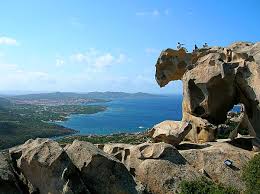 If you'd like to enjoy what's left of the natural beauty of Sardinia (see right) before the entire island is converted into a 'fitness centre' you'd better get a move on. That's right. Berlusconi's glove puppet just became governor. New boy Cappellacci is to Berlusconi as Medvedev is to Putin, so don't expect surprises. In fact, their relationship - in both cases - reminds me of a rather offensive joke about a bad ventriloquist who used to put his hand up his nephew's arse and tell him to keep his mouth shut. Except that Putin and Berlusconi are clearly considered rather good ventriloquists.
A few days before Eluana Englaro died, some gobby cardinal criticised polls indicating a substantial majority in favour of her death by saying that Italians weren't that stupid. He was wrong then, but he's been proved right now.
(OK, the second picture's actually Dubai, but you get the idea...)
Monday, 16 February 2009
Sticks, stones, names
I'm linking to a post I started some days ago but only published today, which you might not otherwise notice. It's about the new security laws in Italy. Here it is. This is a subject I'll be returning to, I just know it.
Friday, 13 February 2009
First official sighting
 Not quite the first sighting of Little Monsters with its 3for2 sticker proudly displayed in the bottom right-hand corner, but the first to be substantiated by a photograph. Here I am, snuggling up to David Leavitt, with Jeffrey Eugenides obliquely at my feet and an intriguing book that appears to have a large hole cut out of it just above my head. Elsewhere, I've heard, I'm bang up against La Petite Anglaise. Hmm.
This comes, courtesy of Charlie Bulbeck, from the Bristol branch of Waterstone's. Thank you, Charlie!
Thursday, 12 February 2009
International relations
Barack Obama finally called Berlusconi yesterday. He ordered four pizzas with peperoni and two bottles of Nastro Azzurro.
Tuesday, 10 February 2009
Death and the state
Last December I posted on the case of Eluana Englaro, an Italian woman who had been in a state of vegetative coma for the past seventeen years, following a car accident when she was twenty. After years of legal to-ing and fro-ing, buck-passing and prevarication, her father, Beppino, finally obtained permission last July to discontinue treatment and allow his daughter to die, in accordance with her own verbally expressed wishes.
When I wrote my post, the Minister of Welfare, Maurizio Sacconi, a man who had previously shown no marked religious inclinations, was threatening to close the clinic in which the treatment - a pharmaceutical substance providing nutrition and preventing dehydration - was to be withdrawn, despite the fact that Italy's supreme court, the Cassazione, had authorised its discontinuance. According to Sacconi, the state could neither condone nor authorise murder. In any case, said Sacconi, as the self-elected mouthpiece for the Vatican, Eluana's life belonged not to her, but to God.
Since then, and despite a public consensus that, perhaps surprisingly, ignored the anathema of Italy's increasingly vociferous pulpits and sustained Beppino Englaro's struggle, the situation has developed into one that threatens not only the right of one woman to die but the entire democratic structure of Italy, such as it is. Over the last few day, flying in the face of Italy's president, Giorgio Napolitano, and the warnings of constitutionalists, Berlusconi and his government have been involved in an attempt to improvise a one-paragraph law to 'save Eluana'. The attempt was interrupted by her death, yesterday evening, two days after treatment had been stopped, as a result of cardiac arrest.
It may be the case that some of the people who fought and shouted and legiferated for Eluana's body to be medicated and watered, washed and treated and turned two, three times a day, for her hair and nails to be clipped and her bodily wastes removed - it may be that some of them genuinely believed she was alive in some meaningful way, and that the right to die should be denied not only to the sentient, as is still the case in Italy, but also to the mindless larva Eluana had become. And there's a sort of sentimental absolutism about that position that might even be worth respecting if it weren't applied so readily, and so cruelly, to those who don't share such a belief and abandoned with such alacrity when the body in question is that of a pope or potential saint.
It may even be the case that some of the religious figures who are now praying that their ever merciful God forgive Beppino Englaro - defined, with infinite understanding, as 'both judge and executioner' by the Vatican house organ today - it may be that some of these cardinals and bishops actually believe in the sanctity of life so certainly, so irrefutably, that even the mechanical ticking-over of a body incapable of thought and emotional response is considered to be a life worth living, whatever the views of the body's owner, now irretrievable, and of those closest to them, their family and friends and loved ones.
But it certainly isn't the case that Berlusconi - who announced that Eluana was 'still able to have children' as though fertility and the ability to be impregnated were the final measure of a woman's value - cared one jot about Eluana's right to live. And it certainly isn't the case that politicians like Gasparri and Mantovano, who, until a handful of years ago, belonged to a party that claimed direct descent from a regime that denied not the right to die but the right to live to hundreds of thousands of Jewish fellow citizens, and homosexuals, and communists, and gypsies, have the interests of Eluana Englaro in mind when they scream 'Murderer' at her father.
Because it isn't the dignity of life that's being defended here, but the vulgar and unseemly - for want of a stronger word - interests of a caste. And when that caste, in its efforts to subvert the constitution and with the assistance of a power-obsessed clerical hierarchy, is prepared to take advantage of the lingering death of a woman and the suffering and civil conscience of her family, it isn't difficult to recognise who's standing on the moral high ground.
Friday, 6 February 2009
Sticks and stones will break my bones, but names will never hurt me
I started writing this post over a week ago. This is what I said.
Italy took one more large step towards an effectively fascist regime the day before yesterday with the approval by the senate of a bundle of legislative measures labelled 'security'. They look like a knee-jerk reaction to recent acts of violence committed by 'foreigners', but this isn't the case for a number of reasons, which I'll talk about below. The measures are part of a xenophobic plan designed by the Lega to placate its electorate and, shamefully, supported by its allies in parliament in order to ensure the tenure of the current government. Perhaps 'plan' is too grand a word for the illiterate blatherings of Bossi and his gang of small-town bullies and petty bureaucrats from the imaginary land of Padania, but the effect they're likely to have is much the same as other 'solutions' dreamed up in the recent, and not so recent, past.Italy is now the only country in western Europe in which a government minister (Bossi) can refer to immigrants as 'bingo bongo' and maintain, indeed reinforce, his position, and in which an MEP (Borghezio) can continue to be regarded as a politician after being convicted of criminal violence inspired by racial hatred. People seem to have become used to the presence of these people, which is the most worrying aspect of all, because indifference is precisely the humus that allows new laws of this kind to pass without protest, or sufficient protest.Let's take a look at the new measures. Immigrants who apply for a permesso di soggiorno (permit to stay) will be expected to pay a tax of between 80 and 200 euros for the privilege. Those without a permesso di soggiorno will be denied medical care, and any doctor or medical worker who provides it will have the right to report the patient to the police. The same goes for anyone who assists an illegal immigrant to send money home to his or her country. Citizens (Italian) will have the legal right to form bands to patrol the streets to protect themselves and fellow citizens from violence.
And then I gave up, nauseated, but also side-tracked by the Englaro case and the odd display of skewed values the two events seemed to reveal of Italy. The life of a brain-dead woman had suddenly become more valuable than that of the many hundreds of thousands of workers without whose daily contribution the Italian economy would grind to a halt. Eluana, it seeemd, had the right to live, the right to medical treatment about to be routinely denied Mohamed or Luis or Maddalena (except that, for Italian politicians, the only immigrants to have names are the ones who wipe their grandmother's arse or clean their shoes for them). And I was side-tracked too by the news that a Northern League mayor in the Friuli region had issued an ordinance that, alongside the usual ban on burkas, obliged all restaurants, including ethnic ones, to serve traditional Friuliano dishes, and by Wendell's post on a little financial incentive being offered by fascists in Basilicata to ensure that the names Benito and Rachele live on. In case you don't know, these are the first names of Mussolini and his wife, last seen hanging by their heels in Piazzale Loreto. And I thought, Look on his works, ye mighty, and despair.


Thursday, 5 February 2009
Reading group? Listen up!
If you're a member of a reading group, or would like to set one up, or know anyone who's already a member of a reading group, or think your next-door neighbour may once have belonged to a reading group, or have recently overheard someone on the bus talking about a reading group and think she may be traceable if only by her Yogi Bear and Booboo earrings, or... well, that's it. I just wanted to let you know that Picador, in its infinite wisdom and generosity, is offering a sizeable discount on the paperback of LITTLE MONSTERS for, er, reading groups. End of promotional message. Back to work.
Wednesday, 4 February 2009
Boys will be boys
If you look in an English-Italian dictionary for a translation of the word ragazzo, you'll find 'boy', followed by 'boyfriend', 'young man'. Italians of all ages frequently use the word to address a group of friends, the irony more evident as the age of the group increases. But it's a good word on the whole, a word that expresses affection and solidarity, particularly when it's addressed to people who fall outside its strict chronological range. So it's been interesting in the past few days to see how the media use the word.
Italy's seeing a lot of street violence at the moment, or, at least, the media are paying a lot of attention to it. All news is mediated and it would be naive to pretend otherwise, but there's an interesting distinction that needs to be made between two kinds of mediation, particularly with television reporting. The first is the air of general obedience to whoever holds political sway within the country or, more importantly, to the editor in control of the specific news programme for which the journalist works; invariably a political, or party, nomination. Bruno Vespa, a TV journalist who's tough with the weak and supine with the powerful, once referred to the Christian Democrats as his editorial point of reference, although he's certainly revised that view with each election and is now lapping with his usual zeal from the bowl provided by Silvio Berlusconi. This doesn't only happen in Italy, of course, and not all journalists can be tarred with the same brush, but independent monitoring organisations confirm the sense that the news in Italy has, let's say, a marked tendency to bend with the prevailing wind.
The other kind of mediation is linguistic. Among the stories that have been used to distract attention from the economic crisis and the bare-faced indifference of the government to issues not directly linked with Berlusconi's vendetta against the judiciary system are a series of rapes and an act of violence against a homeless person. Most of these rapes have been committed, as far as we know, by Romanians, usually young men, usually in groups. The act of violence, during which a homeless 35-year-old Indian, trying to sleep on a bench in Nettuno station, was first insulted, then beaten up, then covered with petrol and set alight, was also committed by a group of three men, ranging in age from 16 to 29, but these happened to be Italian. The Romanians are, without exception, referred to as Romanians. The Italians, who may be facing a charge of murder if the man dies, which seems likely, are defined as ragazzi.
Leaving Navtej Singh Sidho, recently made unemployed and evicted from his lodgings, with third degree burns over much of his body, the 29-year-old ragazzo sent a celebratory text to friends in Roman dialect: "Gli amo fatto la festa". (In standard Italian, this would be "Gli abbiamo fatto la festa"). Fare la festa is an expression that translates as 'Give somebody a warm welcome'. The irony in Italian is bad enough; in English it becomes almost unbearable.
Tuesday, 3 February 2009
In England - now!
 I'm not actually in England right now, but everyone else seems to be posting photographs of snow and I had this picture my sister sent me, which actually looks like a black and white photograph apart from that wonderful slash of vivid swimming-pool blue, and I didn't want to feel left out, sitting here in my study, looking out on a cloudy grey sky that may be producing snow in the hills to the east of here, but won't be doing that where I live because it almost never does, watching the breeze lift the butterfly chimes on my neighbour's balcony and the still-flowering lantana on my own, and so I thought, why not?
Monday, 2 February 2009
Countdown
 Recognise this? Of course you do! It's the front cover of the paperback edition of Little Monsters. It's slightly different from the hardback - my name's now larger and centred (an entirely thrilling development) and Beryl Bainbridge's generous endorsement has been replaced by a quote from the Daily Mail review saying that the book is 'beautifully written, and more compelling than many thrillers', which says something about the book (its aim) and something about marketing (not its aim). This obviously takes nothing away from my joy, which is unbounded, but I just thought I'd mention it.
 The book hits the shops on Friday, 6 February, and on this occasion I'm not indulging in wishful thinking or hyperbole because it actually will be hitting a much larger number of shops than the hardback edition did. This is because Waterstones branches nationwide (including Wolverhampton - I know, I checked) will be including it in their 3 for 2 offer, so the book should be stacked up on tables all over the country, rubbing shoulders with The Gone-Away World - Hi, Nick! (It's 3 for 2, I can afford to be magnanimous) - and all kinds of other great reading experiences. (This is what happens when I slide into promotion mode - my language goes.) And those of you who are travelling in the next few weeks should see even more copies at WH Smith Travel shops in stations and airports throughout the UK, where it will be available in their Buy One Get One Half Price offer. Yes! Naturally, since I won't be there to witness this, I'm looking forward to all your sightings, preferably with photos. So prime your mobiles...
I was going to save this post until Friday, but I couldn't wait. Now I'll have a dreadful sense of hollowness for the next four days.
PS I wanted to call this post 'Countdown to...' well, something, so I googled 'countdown to' for inspiration and found, to my dismay, that the two most frequent words to follow the phrase, apart from Christmas, which clearly isn't appropriate except metaphorically, are 'extinction' and 'armageddon'.
Subscribe to:
Posts (Atom)