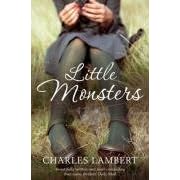
Recognise this? Of course you do! It's the front cover of the paperback edition of Little Monsters. It's slightly different from the hardback - my name's now larger and centred (an entirely thrilling development) and Beryl Bainbridge's generous endorsement has been replaced by a quote from the Daily Mail review saying that the book is 'beautifully written, and more compelling than many thrillers', which says something about the book (its aim) and something about marketing (not its aim). This obviously takes nothing away from my joy, which is unbounded, but I just thought I'd mention it. Monday, 2 February 2009
Countdown
Recognise this? Of course you do! It's the front cover of the paperback edition of Little Monsters. It's slightly different from the hardback - my name's now larger and centred (an entirely thrilling development) and Beryl Bainbridge's generous endorsement has been replaced by a quote from the Daily Mail review saying that the book is 'beautifully written, and more compelling than many thrillers', which says something about the book (its aim) and something about marketing (not its aim). This obviously takes nothing away from my joy, which is unbounded, but I just thought I'd mention it. Friday, 30 January 2009
Aiming at foot, hitting foot
Tuesday, 27 January 2009
A sudden calm
Sunday, 25 January 2009
Baa baa black quilt
Thursday, 22 January 2009
Happy birthday, dear blog
Tuesday, 20 January 2009
Dropping in at Edge Hill
"If anything is going to restore the popularity of short fiction in this country, it must be the publication of stories such as these, by turns humorous, surreal, disturbing, but always memorable."
"Now, gentle reader, buy the book! "
Monday, 19 January 2009
One morning, when Pietro Citati woke from troubled dreams...
Saturday, 17 January 2009
Feeling thorny?
March for Equality
Friday, 16 January 2009
Isak Dinesen? Yes!
Tuesday, 13 January 2009
Update from the very dark cave
At a recent Sunday morning service at the Cowboy Church of Ellis County, the Rev. Jess McCabe, a visiting pastor, held up different sizes of deer antlers to illustrate his sermon about how people grow as Christians.
"That's one thing about cowboy church — we all got room to grow," McCabe told the congregation with a smile.
Well, hi ho, Silver!
Coffee and Cronenberg
Tease
Monday, 12 January 2009
Talking Heads: Bringing down the House
Thursday, 8 January 2009
Pickles
EFS, for those of you who don't know, is the grandson of the last king of Italy, forced to skedaddle after palling up to Mussolini. His father, Vittorio Emanuele, a slack-faced halfwit with the brains and moral equipment of an amoeba, managed to use his 'business' contacts under the last Berlusconi government to have the whole gang re-admitted to the country after decades of gilded exile in Geneva, Paris, Sardinia (yes, Sardinia is in Italy, but money makes borders permeable).
Since their return, Daddy Savoia has been in trouble with the law for various 'business' dealings involving gambling, sex slavery and prostitution, and, along with his son and wife, a botoxed biscuit heiress who makes Ivana Trump look classy, has sued the Italian government for moral damages. (More about this here.) EF's first bid for stardom (in the televisual sense) came when he endorsed a pickle manufacturer. Along with many others, I wrote to the company to suggest that this wasn't a wise choice and received, within seconds, a long, carefully-worded email in which the pickle makers hedged their bets, defended their decision, apologised, etc. Two days later, the ad disappeared
Since then he's entered politics, running for a party whose name I forget and registering the polling equivalent of nul points. His political sympathies remain on the market, for anyone who might regard them as a worthwhile investment. He was last in the news just over a year ago when he refused to pay a speeding fine. He refused to pay for two reasons. The first was that he wasn't driving the car at the time. The second was that the road signs weren't very clear. This is known in legal circles as the Billy Bunter defence. (As in: I never ate the cake. And, anyway, it was horrible.)
Ballando con le Stelle starts on Saturday. Waltz on, Pickles.
Tuesday, 6 January 2009
Scones and tales
Sunday, 4 January 2009
Saturday, 3 January 2009
Thursday, 1 January 2009
Omega Minor
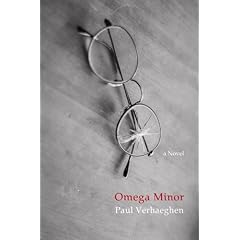
I’ve just finished reading Omega Minor by the Belgian novelist Paul Verhaeghen, a cognitive psychologist now working in the States. Originally published in Dutch, this enormous novel – 700 pages of closely-printed text - was translated into English by its author, winning the Independent Foreign Fiction prize in the process. The English, like the novel itself, is constantly inventive, and slightly quirky; Verhaeghen has stated that he decided to do the translation himself after seeing the lamentable job a professional translator had done of a section of the book, and I can well believe it. It isn’t a job I’d have taken on willingly, and certainly not at the rates a work this size inevitably attracts if it’s to exist at all. It’s a sprawling, superficially confused, engagingly unwieldy sort of book that resists unity of style, that resists, in many ways, any kind of unity at all, except that provided by its existence as an attractive, slightly austere, well-made physical artefact, for which we have, once more, the Dalkey Archive to thank.
The narrative arc of the novel covers much of the last century, with key events clustering around the opposing poles of the Second World War and the destruction of the Berlin wall. Geographically, its heart is Berlin, although long sections are set in New York and Los Alamos, and one short section in an improbably glamorous Bath, a place I suspect Verhaeghen has never seen. It’s a book that barely acknowledges a world beyond that defined by mid-twentieth century Europe and the post-war diaspora, except – in the case of Japan - as a target for the nuclear bomb. There’s no reason why it should. It has more than enough on its plate as it is.
The novel opens with a description of a sexual encounter that sets the tone for most of the sex in the novel. There isn’t that much of it in terms of pages, but what there is shares a relentless, near-pornographic quality that might have something to do with Verhaeghen’s not being a native speaker. It’s a strange amalgam of the poetic, the urological and the simply weird, as in this extract from the second page:
Behold the purple head that sways so swiftly on its heavy stalk; see how it glistens with her spit and juices; watch the little crater at the top spit out its zigzag line—out shoots the slime, the whirling weathervane, the drunken comet that climbs past the stars: In the moist cloud chamber of Donatella’s room, a signal lights up in silvery white, an almost perfect circle described by the tumbling ribbon of spunk, an acrobatic snake snapping at—but missing—its own tail: an ancient Greek symbol, the latter Omega, capitalized—Ω.
This opening scene does more than establish the tone and central elements of the novel’s theme. Crucially, the sexual act is being described not by a protagonist, but by someone who observes, himself unobserved. The novel is deeply concerned with what it means to be a witness, and with the kind of power, and lack of power, this involves. It goes beyond this to question the nature and permeability of the boundaries we draw between those who act and those who watch, and how historical and personal blame should be apportioned between these two groups, taking into account the extent to which any distinction made between them might be facile, or false. Dangerous ambiguities are evoked as the novel progresses – through confession and dissimulation - and even the aphoristic moral certainty of such a sentence as “There is a world of difference between an act that is permitted and an act that is permissible” is undermined by what the novel does.
Omega Minor is designed to be seen as a book that works on multiple levels. Its refusal, for example, to utter the word God, preferring G*d, suggests that it sees itself as a sort of holy text, as one that runs the very real risk of blasphemy, or, alternatively, as a text that denies God and demonstrates its denial on the page. The action jumps, often irritatingly, from one time and place to another, often without identifying the central character or narrative viewpoint, leaving the reader to flounder for a page or two and sometimes, when a new character is introduced without warning, for considerably longer. It draws on religion, and history, both personal and political, and science both as bodies of fact and as sources of metaphor, as though there really were a mystery at the heart of things that might be revealed. Which mystery, in the end, is what provides the novel with its – for me –unsatisfactory climax. The novel’s over-written at times, and under-imagined at others, particularly when it talks about love, and I found it hard to care for anyone other than the one person who perhaps deserved it least. At the same time, and despite these misgivings, I found the book deeply absorbing, and the time spent reading it time well spent. If what I was left with was a very traditional sense of the sheer awfulness of its material, for want of a better term, rather than a new understanding of the way in which the material is being reworked, by history and time, by deniers and apologists, this didn’t detract from the very powerful impact the book made on me. It’s not damning with faint praise but its diametrical opposite to say that this book is over-ambitious. I recommend it.
Think Pink
Wednesday, 31 December 2008
Tiny Deaths by Robert Shearman
What a powerful and wonderful book this is. In deliberately toned-down and undemonstrative prose, Shearman takes the lives of average people, suburbanites, office-workers, the patiently married, the mildly disappointed, and, with one single fundamental shift of perspective (for want of a better word), creates a reality that surprises, informs and moves, often deeply. I found most of these stories compelling, touching, occasionally gut-wrenching, often funny, with a capacity to tell truths about the way we live that many far more ambitiously written books just don't have. It's the kind of book you want to press into other people's hands.
View all my reviews.
Monday, 29 December 2008
Intimacy
Some weeks before Christmas, well past the watershed, RAI2, one of the Italian state TV channels, showed Brokeback Mountain. Well, actually, it didn't. It showed a version of Brokeback Mountain shorn of its moments of intimacy. Brokeback Mountain without intimacy is another film entirely, and this was pointed out to the head of RAI2, who claimed it was all a terrible mistake - the bowdlerised copy had been prepared for another section of the RAI (presumably under total Vatican control) - and would be remedied forthwith. I've been told by a RAI director that it's damn nigh impossible that a film be broadcast without its having been seen by someone, but why should I doubt the word of a Warped!
Like Banner, Lambert likes to narrate from a dizzying array of perspectives — i.e., male/female, gay/straight (though he carefully avoids such terminology, thankfully) — and also like Banner, Lambert’s characters are not ones you’d like to consider friends...
we cannot read any of these stories without a sinking feeling that something bad is about to happen, leaving us with the question of whether the damage will be psychological, physical or some combination.Sounds good...
21
"a peer-reviewed, online critical journal exploring contemporary and innovative fiction. We are interested in cutting edge fiction from the late twentieth and early twenty-first century, whether in the short story, the novel or hybrid forms; in print or hypertext. This includes all literature written in English or published as translation."
What Lawrence might have called a pansy
Sunday, 28 December 2008
C'est si bon
One of the great television moments of my childhood was watching Eartha Kitt being carried onto the stage of the London Palladium, slinkily curled up on a leopardskin-clad chaise longue borne on the shoulders of muscular men in loincloths, to sing Old Fashioned Millionaire. She taught me all I needed to know - I couldn't have been more than eight or nine - about glamour, possibly too much. I also remember the thrill that the song's audacious rhyming (Cadillac/in the back - but you need the whole couplet to get the full joy) gave me. Eartha Kitt was always there for me, in a way that Harold Pinter, this Christmas's other illustrious death, never was. When she came back, powerfully, in the 80s with Where is my Man, I was waiting for her. We all were. More rhymes, more sexiness, this time laced with anguish, which made me love her all the more. Pinter's politics won him the Nobel Prize; Kitt was sent into what the US saw as exile (Europe!) for over twenty years for haranguing Lady Bird Johnson about the Vietnam war. This isn't to diminish Pinter's voice and what he did with it, though his poetry, which no one seems to have mentioned, was utterly awful, but the risk Kitt ran was of a different order.
Wednesday, 24 December 2008
Gaia
Tuesday, 23 December 2008
Today Scott Pack's top 10, tomorrow the world
Friday, 19 December 2008
Thursday, 18 December 2008
Seventeen years
Tuesday, 16 December 2008
This is all we need
I worried about this some time ago. It looks as though I was right to be worried.
Christmas spirit: an antidote
Last blast before Christmas

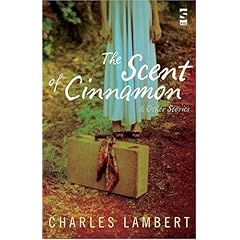
John Self has done my Something Rich and Strange virtual book tour proud on his Asylum blog, where I rub shoulders with some of my favourite writers, such as James Kelman and, barely a spit away, Penelope Fitzgerald. It's thrilling to see his critical eye turn its gaze my way. You can read his review of The Scent of Cinnamon, along with the interview, here. Among other things, he compares me - favourably - with Roald Dahl's adult fiction and suggests that maybe you can have too much of a good thing...
Monday, 15 December 2008
Saturday, 13 December 2008
Friday, 12 December 2008
Everything I Have is Blue
Tuesday, 9 December 2008
Nel mezzo del cammin
Five down, five to go. The latest leg of my Something Rich and Strange tour is posted today on Vanessa Gebbie's News. I've been a fan of Vanessa's work for as long as I've been blogging (and here's the proof), well before we found ourselves rubbing shoulders in the Salt stables. So it was, as they say, both a privilege and a pleasure to answer her questions on two of the longer stories in the collection. They're both set on Mediterranean islands, so pack your sunglasses.
Saturday, 6 December 2008
Lamed vovnik
In Jewish lore there is a legend of the lamed vovniks, the thirty-six just men on whom the existence of the world depends (Sarah would have had something to say about the gender prejudice of that). According to the legend, God had become so disgusted with his creation that he was determined to destroy it. But an angel came to plead with Him and to ask for a reprieve if she could find thirty-six just men in the world. In every generation, so the legend goes, there are always thirty-six just men – the lamed vovniks on whom its continued survival depends. The lamed vovniks are not conscious of who they are. They perform their acts of compassion and love out of the purity of their hearts. And the rest of us owe the world to them.
Lovely things
Money
Friday, 5 December 2008
Thursday, 4 December 2008
Questionnaire
- What do you think caused your heterosexuality?
- When and how did you decide you were a heterosexual?
- Is it possible that your heterosexuality is just a phase you may grow out of?
- Is it possible that your heterosexuality stems from a neurotic fear of others of the same sex?
- Do your parents know that you are straight? Do your friends and/or roommate(s) know? How did they react?
- Why do you insist on flaunting your heterosexuality? Can't you just be who you are and keep it quiet?
- Why do heterosexuals feel compelled to seduce others into their lifestyles?
- A disproportionate majority of child molesters are heterosexual. So you consider it safe to expose children to heterosexual teachers?
- With all the societal support marriage receives, the divorce rate is spiraling. Why are there so few stable relationships among heterosexuals?
- Statistics show that lesbians have the lowest incidence of sexually transmitted diseases. Is it really safe for a woman to maintain a heterosexual lifestyle and run the risk of disease and pregnancy?
- Considering the menace of overpopulation, how could the human race survive if everyone were heterosexual?
- Would you want your child to be heterosexual, knowing the problems that s/he would face?
Remember: no Salt, no flavour
Tuesday, 2 December 2008
Casting away
Iran, Jamaica, Vatican, Sudan....
Grooming
I wasn't sure I would like this book. A tale of a young girl setting up home with her uncle sounded terribly seedy.
The story is narrated, in reflective mode, by Carol Foxe, the young girl in question, whose dad has murdered her mum so is put into the 'care' of her selfish and hard-hearted aunt Margot and attentive Polish uncle (Joey) Jozef who live over the pub they run. HIs friendliness towards her as a child - come to the basement, come for a walk, I have something to show you, don't tell your aunt - all smack of grooming. The intention may have been to give an air of innocent caring and concern towards the young girl but it struck me as highly inappropriate.
Cyclone tour: stage four
My Something Rich and Strange virtual book tour, to celebrate the publication of The Scent of Cinnamon and Other Stories, goes from strength to strength. This week's event is hosted by Jim at Jockohomo Datapanik and it's a corker. I talk about the gay aspects of the collection, something that hasn't
really been touched on before. If you want to know what turned me on as a teenager, and what turns me on now as a reader, this is the place to go. Plus you'll get the chance to explore Jim's many other interests, which include, in his own words: Painting, making art, music, writing, design, bodybuilding, wrestling, new media, photography, sports, architecture, computers, technology, museums, food, travel, languages, lacrosse, mountain biking, film, Warhol, pop culture, op art, biceps, books and blogs +.