Croatia is 90% catholic. Nice one, Ratzy.
Showing posts with label race. Show all posts
Showing posts with label race. Show all posts
Friday, 10 October 2008
Croatia. The Mediterranean as it once was?
Thinking of going to Croatia on holiday? Read this piece by Diamond Walid and see if you fit into the rather narrow range of sexual and racial acceptability demanded by Croatian youths on the lookout for victims (you know, the kind that 'ask for it'). If you do, think about whether you want to have a holiday in a place where the range matters. If you don't, think twice.


Saturday, 17 May 2008
Quotas: footnote
It looks like it's all to do with numbers. How many people come in, how many people are forced to leave. Alemanno says he's going to expel 20,000 illegal immigrants from Rome and I wonder how he arrived at this number, the way I wonder how Stalin arrived at his daily quota of traitors to be arrested and tried and murdered. Do these people use pins, or dice, or multiples of their birth date? And if the numbers don't tally, what then? If there simply aren't enough clandestini? Or too many?
Numbers are part of the rhetoric. The number of Italians who want gipsies expelled, according to a recent opinion poll, is 61 in every hundred. And yes, that includes the 70,000 gipsies with Italian citizenship (as potential expellees, obviously: they're hardly likely to have been asked their opinion on the matter). But what was the question, and how was it framed?
On Annozero the other night, a middle-aged man from, I think, Morocco said that immigrants weren't chattels, to be bought and sold, but human beings. He went on to accuse Roberto Castelli, ex-Minister of Justice, of being a delinquent. This is the kind of language that's used all the time during political debates on Italian TV; it's actually tamer than most. It isn't unusual to hear politicians merrily calling each other shits on prime time telly. Normally nobody bats an eyelid; at worst, there's some muttering about vulgarity in the next day's papers. On this occasion though, Santoro, the ringmaster, silenced the man (physically, by turning his microphone off) and, using the familiar 'tu' form, said he was doing his cause no good and should be more careful before he spoke. Castelli was then allowed to use this act of lèse majesté as an example of how 'they' come over here, insult us, think they have the right, etc. etc.
But how many people watched the show?
Numbers are part of the rhetoric. The number of Italians who want gipsies expelled, according to a recent opinion poll, is 61 in every hundred. And yes, that includes the 70,000 gipsies with Italian citizenship (as potential expellees, obviously: they're hardly likely to have been asked their opinion on the matter). But what was the question, and how was it framed?
On Annozero the other night, a middle-aged man from, I think, Morocco said that immigrants weren't chattels, to be bought and sold, but human beings. He went on to accuse Roberto Castelli, ex-Minister of Justice, of being a delinquent. This is the kind of language that's used all the time during political debates on Italian TV; it's actually tamer than most. It isn't unusual to hear politicians merrily calling each other shits on prime time telly. Normally nobody bats an eyelid; at worst, there's some muttering about vulgarity in the next day's papers. On this occasion though, Santoro, the ringmaster, silenced the man (physically, by turning his microphone off) and, using the familiar 'tu' form, said he was doing his cause no good and should be more careful before he spoke. Castelli was then allowed to use this act of lèse majesté as an example of how 'they' come over here, insult us, think they have the right, etc. etc.
But how many people watched the show?
Friday, 16 May 2008
Quotas
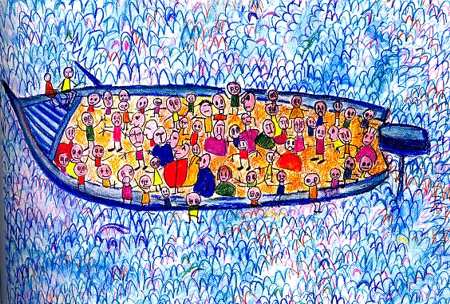 We live in interesting times, as the Chinese curse has it. A few months ago, after reading about the treatment meted out to refugees in Britain and thinking about the mood of anti-refugee rage I encounter so often when I'm there, I wanted to write a short piece on how Italy, despite the xenophobic legislation enacted by the previous Berlusconi government and the lackadaisical failure of its successor to address the issue, still maintained a sense of the shared humanity of the other - faint, flickering, barely enough to light a cupboard by, but still, despite everything, alive. You could see it in the tone of TV news reports when people died while crossing the Mediterranean in boats that should never have been allowed to leave their harbours and the port of Lampedusa was paved with body bags. The images we saw were of kids who didn't look old enough to have left home, never mind homeland, shivering in blankets, drinking something hot, wondering what now? The attitude wasn't approval, far from it, but there was an ounce or two there of understanding, and of pity. I wanted to talk about this, and about how often ordinary people, on buses, at markets, would refer to immigrants, whether legal or not, as poveri Cristi. They might not want them, but they recognised them. I've seen all kinds of people step in when police try to arrest the Africans selling their pirated CDs and fake Louis Vuitton handbags and Dolce e Gabbana shades.
I don't think this is true any longer. I think the mood has changed and that what looked like a sort of prelapsarian innocence - because, of course, it wasn't innocence at all, but nuanced and humane - has now been lost. It would be easy to point a finger at the Northern League and its shameful exploitation of racist sentiment in the north, where half the factory
 workers are illegal immigrants and 100 percent of the live-in carers, without whom the old and ill would be institutionalised or alone, come from outside Italy, from the Ukraine and Indonesia and Brazil. It would be easy to blame the press, which for political motives or worse, has exaggerated the criminal impact foreigners have had, devoting pages to Romanian hit and run drivers and paragraphs to the home-grown kind. It would be easy to blame the last government for its failure to understand the extent to which the agenda - in this as in everything else - was being set by others, which crucially underplayed the security issue, which flip-flopped between the draconian measures taken in Bologna by Cofferati, ex-darling of the left, and the ill-thought-out laissez-faireism of those who wanted to woo the radical youth of the centri sociali, paying lip service to both. It would be easy, finally, to blame the tiny percentage of immigrants who do rape, and murder, and plough down pedestrians in cars they're too drunk to drive.
They're all to blame, I suppose, and the people who came to Italy to improve their lives, and those of their families, and who, in doing so, have also improved the lives of those around them by doing jobs nobody else wants at wages nobody else would accept, by looking after the people we don't have time for, for whatever reason - well, those people are going to have to sit out the storm, hoping their papers, if they have them, are in order, contributing to a national insurance scheme that would soon be belly-up without their money, being humiliated on a daily basis by people who now feel what they had in common with the other has somehow been rubbed away by a too daily contact, by too much friction. On Rai 2's Annozero last night, someone commented that what we really want from immigrants is for them to work from Monday to Friday and then to disappear until they're needed again, and this was wryly accepted by almost everyone there. And now there's a comment on my THES article about lettori in Italy, which shocked me, by someone who left the country because he couldn't take the racism here. And it makes me wonder how I managed not to see it for so long.
Thursday, 15 November 2007
Warwick Collins: Gents
 Cottaging – the use of public lavatories for fugitive sexual encounters – can be thrilling, titillating, dangerous, delusory, exquisite, sordid, debasing, indescribably erotic, and all these things at once. I should know. I spent a brief summer over thirty years ago as an habitué of the cottage on Jesus Green, Cambridge. Indeed, my first published story talks of the experience, and many gay writers have described their own, or others’, sexual encounters in cottages. But it had never occurred to me to consider the subject from the point of view of the people who work in public conveniences, as they used to be called, or restrooms, as Senator Larry Craig would have it. Warwick Collins, in his wonderfully engaging short novel, Gents, gives everyone the chance to see what goes on behind the door marked MANAGER.
 Work as a subject is sorely neglected by fiction; few writers, with the notable exception of Magnus Mills who does almost nothing else, draw inspiration from the mundane tasks we perform or have performed for us on a daily basis. Gents, though, describes with lyricism and precision the working lives of the three men running a municipal public lavatory in London. The men, all three originally from Jamaica, have different attitudes to the use of the place by homosexuals – or, as they refer to them, ‘reptiles’. Jason the Rastafarian disapproves, but sees the problem in racial terms. Reptiles, for him, are white men:
“Whitey cold,” Jason said. “Cold inside.” He began to utter the dark poetry in his soul. “Colder than reptile. Don’ have no emotions. Come to de Gents for de sex wid another reptile. Don’ come for the wife, don’ wan family, maybe don’ even want de other man. Come. Afterwards go.”
The supervisor, Reynolds, is less judgemental. His main concern is that the council doesn’t decide to close the place down and put all three of them out of work. As he says: “We don’t keep their conscience, we only keeping order.” Later, he comments: “Reptile not dangerous. Danger come from man who hate reptile.”
The third man, Ez, who provides the novel’s main focus, is initially incredulous that such things happen, then, despite himself, curious and, finally, thoughtful. In one finely-written passage, he is described observing a cubicle in which two men are having sex:
Ez glanced at the cubicle. It seemed, in the fervent silence, that it was vibrating slightly, like a washing machine, as though various pieces of clothing were being thrown against the side. Then the machine seemed to switch itself off, to utter a soft sigh.
Talking to his wife, Martha, - and the relationship between Ez and Martha is one of the subtlest things in the book - he distinguishes between gay behaviour and what the reptiles get up to.
“Maybe these people not gay. Gay men mostly don’t have to come to dis place. Go to other places. Dese men family men, lonely men.”
As the novel develops, the complex, interdependent relationship between the two groups, each, in its way, oppressed and at risk, becomes more evident. When the ecological balance that enables the attendants and the ‘reptiles’ to survive is threatened by bureaucracy in the form of the implacable Mrs Steerhouse, something needs to be done. The solution the three men find – and I won’t reveal it here - is both humane and practical.
This short novel says more about racial tension, the economics of labour and sexual politics than many books ten times its length. It could have been anti-gay but contrives to have a grace and lightness of touch that distinguish it from more widely-known overtly gay-friendly books. As an ex-reptile I wholeheartedly recommend it.
You can buy it here.
Subscribe to:
Posts (Atom)